
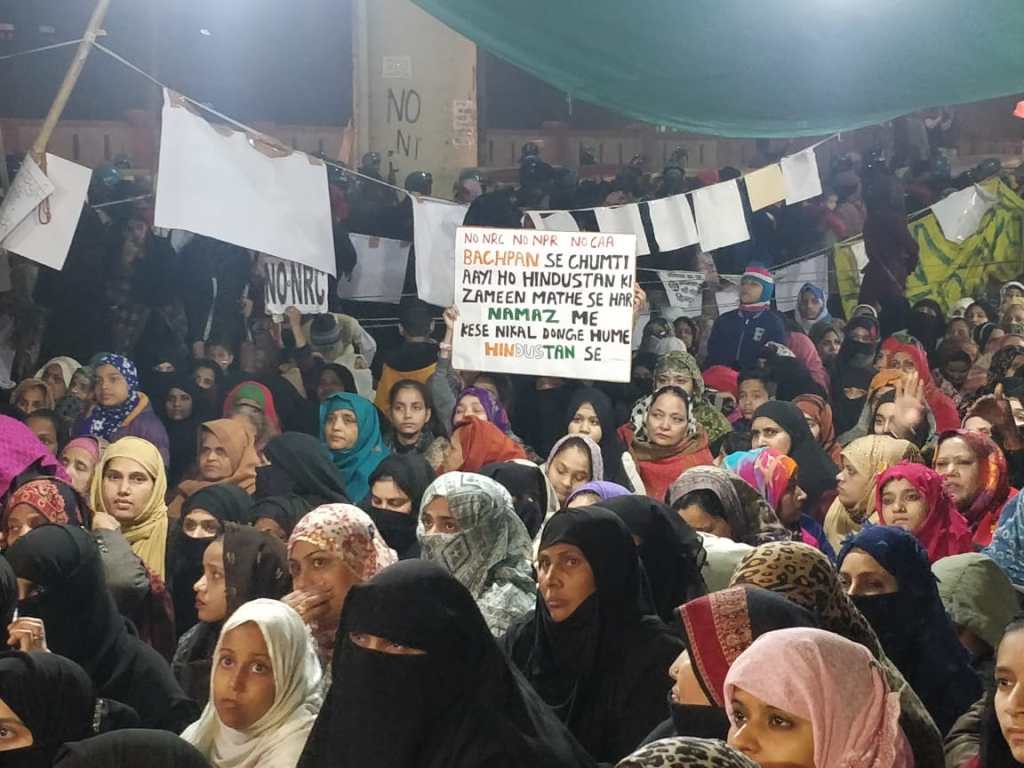
On 29th December 2019, Shashi Tharoor, in a tweet, identified the chanting of ‘la ilaha illallah’ at an anti-CAA protest at Jamia Milia Islamia with “Islamist extremism”. The statement is also known as the Shahada and is a basic tenet of Islam – its literal translation being ‘there is no God but God’. The Shahada is one of several symbols that have been employed in the anti-CAA resistance by Muslims – other symbols include the Indian flag and the Indian constitution (which have also become popular symbols of resistance for all sections of the population).
Tharoor’s view is problematic, but common among non-Muslim Indian liberals, who want Muslims in the country to be Muslim enough, but not too Muslim. This kind of ‘secular Islamophobia’ manifests itself in the restriction of spaces to use Islamic symbols in the articulation of identities in everyday living. The ‘good Muslim’ is visualized as one who would, for the most part, be irreligious (in order to be ‘secular’), disassociate themselves from orthodox Islam, exalt their nation as the primary marker of their identity, and most importantly, be the striking opposite of the terror-inflicting Islamic jihadi. Such notions invariably involve the belief that Indian Muslims, as a whole, form a homogenous category. My school environment was an open and liberal one, where students from well-to-do, middle class families reiterated the ideas that they inherited from their parents, and stereotypical Islamophobic jokes were common. I have had my share of being labelled ‘Osama’, ‘Pakistani’, and as the expert on ‘Muslim language and ‘Muslim food’. (As a result, I developed an inner desire to dismiss the Muslim aspect of my identity – a desire that I only realized and thereafter rejected in my early teen years.)
The marginalization of Indian Muslims has been an ongoing process since Independence and was confirmed by the Sachar Committee Report (released in November 2006) which explicitly revealed the incredibly low social, economic, and educational condition of Muslims vis-à-vis other religious communities in the country. The entire CAA-NRC-NPR project is the most recent attack on the country’s Muslim community and is one of multiple instances where the Indian state has failed the community. What many well-meaning Indians fail to realize is that they, for a large part, are allies in this fight. While the ongoing national movement in India is not limited to the rejection of CAA-NRC-NPR and targets broader issues too, it recognizes that the CAA project is an accelerated attack on the country’s Muslim community and calls out the Indian state on its treatment of Muslims as second-class citizens. The use of Islamic symbols should be viewed and understood within the broader context of Muslim resistance in response to the state’s growing clampdown on the community. It is also to important to note here that our (although not homogenous) identity is one of the few collective resources that the community has left – our assertion of our identity then becomes an act of defiance.
The constant feeling of fear, panic, and anxiety are central to the experience of being a Muslim in India (even more so at this time). As Harsh Mander writes – “Almost no one who bears a Muslim identity is exempt from the fear that they, or members of their families, can be subjected to the allegations of links with terrorist organizations; and to detention, torture, encounter killings, or prolonged, multiple and biased trials… No profession, no part of the country, is safe if you are Muslim.” The commonality of fear among Muslims, across social and economic classes, allows none of us to escape the feeling of being the unwanted ‘other’ in the country. My own father does not have a birth certificate to ‘prove’ his citizenship (it is a different matter that he, under no circumstances, would agree to subject his documents to scrutiny in order to prove his citizenship) and so even middle-class Muslims such as I have nightmares that we will be taken and locked away, and possibly thrown out of the country or worse, end up being surrounded by an angry mob. Religious profiling, too, is an experience that is common among all Muslims – there have been instances in the past where my father has been stopped (in a vehicle) and questioned by the police (on the suspicion of being a ‘Kashmiri terrorist’) due to his Muslim sounding name and appearance. Such experiences usually have the same, upsetting effect on the community – we flatten out and water down our Muslim identity in order to appeal to the idea of the good Muslim and to be ‘worthy’ of the solidarity of our fellow Indians.
While all of us experience similar fear, anxiety, panic, and distress; we experience them differently because all of us do not articulate our identity in the same manner. In general, there is a visible shrinkage of space for the expression of Muslim identity. In this scenario, spaces of dissent then become somewhat safe spaces (that too, only if the dissenting groups recognize themselves as allies alongside us) for us to collectively articulate our identity. Despite the apparent availability of such safe spaces, the fear persists. No matter how much I share with my therapist during our sessions, the fear persists. It grows in intensity. It paralyses. It haunts. And it persists.
In the wake of a national movement against the Indian state and its sponsored brutalities, I have found the most warmth and solidarity with a group that I have always found difficulty in exploring my identification and membership with – Muslim women. Resistance for me has never been as powerful as I have had the opportunity to experience it in Shaheen Bagh, in Jamia Milia Islamia, in Seelampur, in Inderlok, and other places where Muslim women are leading the way. It would be unfair to go on and on about my persistent fear without acknowledging the spaces that have allowed me to experience love and safety.
I do not intend to answer the question that is posed by the title of this article, but I would say that all of us, that is, all Muslims, are Muslim enough to be demonized, to be othered, to be fearful and to be individually attacked. My end note to all protesting citizens (who, I believe, do not need to prove their status in the country – the imposed demand to prove one’s citizenship in the country is preposterous) would be this – understand that this fight is a long one that also rejects the degradation and marginalization of our community, and that you are allies in this specific struggle. Read, research, interact, and realize the extent of suffering and injustice that has been inflicted upon our community – we have never been free, we are never really safe, and we are never not scared. Hum qalma bhi padhenge, hum ibadat bhi karenge, aur hum inqalab bhi layenge.
 Lokayata
Beautifully written!! Opened so many more layers than we were aware of.
LikeLike
Very nice article. Agree with the writer.
LikeLike