Syed Mustafa Siraj’s ‘Bharat Varsha’—Translated by Saukarya Samad

Syed Mustafa Siraj (1930-2012) One of the last sentinels from the golden era of Bengali literature, Syed Mustafa Siraj wrote effortlessly for both children and adults. His sheer versatility enabled him to craft riveting novels like ‘Neel Ghorer Nati’ and conjure the evergreen ornithologist-cum-investigator Colonel Niladri Sarkar. Renowned for his nuanced social commentary and vivid … Continue reading Syed Mustafa Siraj’s ‘Bharat Varsha’—Translated by Saukarya Samad

On the Lokayata Blog: A Round-Table

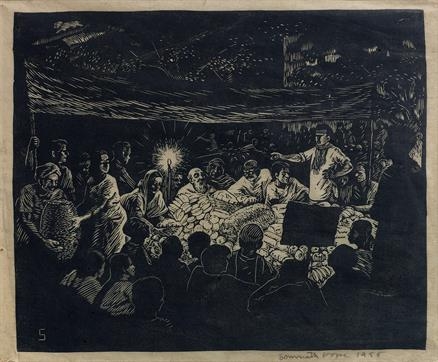
'At the Night Meeting'---Woodcut by Somnath Hore (1955) [Courtesy: MutualArt] On the 4th of June, the members of the Study Circle met to consider the possibility of doing something special to mark the milestone of having the 50th post up on the Lokayata blog, come July. It was unanimously agreed to obtain our own domain … Continue reading On the Lokayata Blog: A Round-Table

Yashpal’s ‘The Right to Grief’—Translated by Riya Lohia

Yashpal (1903-1976) was a prolific Hindi writer, who had written short stories, novels, essays, and a play. An active participant of the Indian freedom struggle, he had been jailed by the colonial government for his revolutionary activities. He was a socialist and saw his writing as a means of intervening in a range of social … Continue reading Yashpal’s ‘The Right to Grief’—Translated by Riya Lohia

The Politics of Demolition and the Displaced People of the Tughlaqabad Village—Monjima Kar

Ruins of the Tughlaqabad Fort. The Tughlaqabad Fort, built around the 14th century, stands in ruins now, seven centuries later. What remains are the various settlements outside the fort enclosure. These settlements are equally old, built around the fort and inhabited by the working-class people ever since. While Ghiyasuddin Tughlaq might have found it difficult to … Continue reading The Politics of Demolition and the Displaced People of the Tughlaqabad Village—Monjima Kar

Ahmed Chhafa’s ‘The Village Poor and Rural Class-Struggle’—Translated by Pritha Banerjee

Ahmed Chhafa [Sofa] (1943-2001) with his teacher, Professor Abdur Razzaq (left). Let us take a village. Assume that it contains a total population of 2000, which includes its men and women, infants and adolescents, young and the old. It is known to all that none of us lives alone in this society. Kith and kin, … Continue reading Ahmed Chhafa’s ‘The Village Poor and Rural Class-Struggle’—Translated by Pritha Banerjee

Agyeya’s ‘The Writer And His Society’—Transcreated by Tushar Srivastava

Sachchidanand Hiranand Vatsyayan, ‘Agyeya’, at his home in Delhi [Image Courtesy: Vatsal Nidhi] Following is an attempt to ‘transcreate’[1] Agyeya’s essay titled ‘Lekhak Aur Uska Samaj’ which is excellently archived in the collections of ‘Vatsal Nidhi Prakashan Mala: Samvitti’ published by ‘Sasta Sahitya Mandal’ — to which I remain very thankful. All meanings of thought, conveyed … Continue reading Agyeya’s ‘The Writer And His Society’—Transcreated by Tushar Srivastava

Corruption Conundrum: The Political Anatomy of a Pecuniary Problem—Ritabrata Chakraborty

Cartoon by R.K. Laxman (Image Source: Public Domain) Often, encountering stunning images makes a deeper impact on us than reading stark facts in text. After years of stalled recruitments, legal deadlocks and sustained protests by a section of the deprived candidates for the School Service Commission examination, the pictures of a massive stockpile of cash, … Continue reading Corruption Conundrum: The Political Anatomy of a Pecuniary Problem—Ritabrata Chakraborty

Samar Sen’s ‘Sans Reverence’—Translated by Suchintan Das

Samar Sen (1916-1987) [Image: Public Domain] The question of livelihood does not arise while discussing the term ‘intellectual’. The Bangla term ‘Buddhijibi’—one who lives off one’s own intellect—is therefore not an accurate translation. Perhaps the remnant of our old Brahminical baggage[1] has lingered on in this rendering. Brahmins were the custodians of intellectual culture and they … Continue reading Samar Sen’s ‘Sans Reverence’—Translated by Suchintan Das

Tribulations for the Future of Classical Arts in India—Arnaaz Zaman

The eviction of veteran Odissi dancer, Padma Shri Mayadhar Raut The insular world of classical arts rarely surfaces on the mainstream news-headlines in India. Yet, the eviction of Mayadhar Raut, the doyen of the Odissi dance form, from his government accommodation in New Delhi brought the fraternity to the fore of the news-cycle.  As images of … Continue reading Tribulations for the Future of Classical Arts in India—Arnaaz Zaman

D.D. Kosambi: Revisiting the Historian and his Legacy—Shashi Singh

D.D. Kosambi bathing his dog Chatya (Image courtesy Permanent Black) Aijaz Ahmad, the legendary Marxist theorist who passed away recently, was of the opinion that universities have been transmogrified into markets and malls selling enticing theories of postmodernism and postcolonialism to students. He was a fervent critic of these theories since he felt that their … Continue reading D.D. Kosambi: Revisiting the Historian and his Legacy—Shashi Singh