
In a 2024 op-ed published in the Indian Express, Manish Sabharwal and Ashish Dhawan (the latter a philanthropist and a founder-trustee of Ashoka University) posed an important question: “Isn’t it impossible to decide which disciplines matter more: The sciences that lengthen our lives or the humanities that make those longer lives worth living?” The article argues broadly for an increase in the investment in our education system, specifically in university education. It is an argument that tends to escape criticism through its seemingly inherent, absolute virtue. The duo states that the country must focus on making sure that at least ten Indian universities should, by the centenary of India’s Independence, be included in the global top 100 university rankings. This seems a tall order in the face of their current position, with 11 universities from the country in the top 500, but according to Dhawan and Sabharwal, this gap can be amended by strengthening the ties between the government and its universities, primarily through the concentration of research funding and goal-oriented grants. India is, in their own words, “fertile ground,” and the opportunity to make full use of the “tipping points in research, budgets, quality and students” (emphasis added) currently being reached in educational institutions (both private and public) throughout the country should not be ignored. India must capitalize on its resources to make sure that it does not lose its place – rather it gains traction – in a rapidly changing international order.
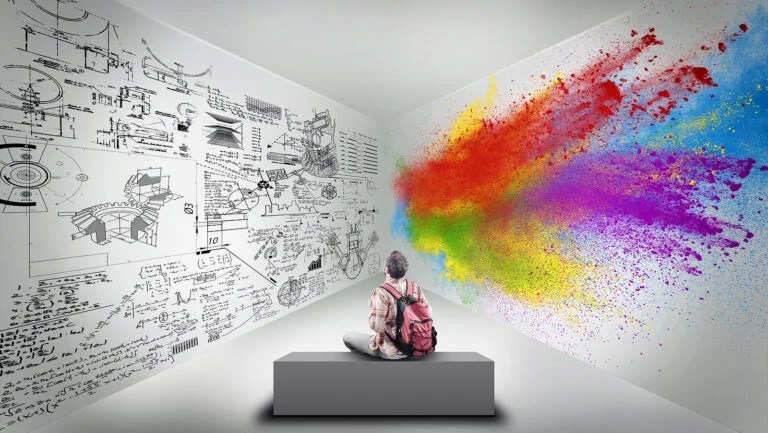
But why construct this dichotomous choice between the humanities and the sciences in the first place? One of the most basic tenets of good pedagogical practice is that a child’s education should be comprehensive and holistic, so why must we starve an entire arena of educational capacity in the country by focusing on one or the other?
Dhawan and Sabharwal argue that a good strategist does not ignore the relationship between shaastra (knowledge) and shastra (weapons), for they are siblings and must be treated as such. They do not construct the binary between the sciences and the humanities as much as they treat it as a foundational building block of education, and within their world, the entry of the Indian university into the global 100 is directly tied to its increased capacity to help national security. It is but another step in deepening the relationship between the university and the military, ostensibly to ensure that the nation is protected and well. A better university that is better in tune with the government can create better industries, and one of these industries, naturally, will be that of defence. That the humanities have no place in this equation is unfortunate, but nevertheless a necessary sacrifice.
The duo never really answers the question they posed, at least not explicitly, but they don’t particularly need to. The fact that the article was written is answer enough. By presenting a situation where there is only one ‘rational’ answer – because how is one to thrive (here associated with the humanities) if one cannot even survive (here helped by the sciences) – and any answer that is not a simple call to a scientific frenzy of technological advancement becomes contrived and childish, almost nonsensically idealistic in its utopian ethos. Of course, we would love to think and criticize, question and disagree, abstract and consider – but how will you do that if you are dead? And how will you be alive if there is no one and nothing to protect you? The sciences, and by proxy all technological advancement, are boiled down to nothing more than a tool for survival to make it easier to qualify the inferiority of the humanities – and naturalizes the inclusion of this technology and surveillance in everyday life, creating a vicious cycle of visibility, perceived usefulness and increased proliferance.
The reductive definitions of what the ‘sciences’ and the ‘humanities’ mean are genius precisely in their plainness and lack of depth, because to stereotypically define them respectively as a necessity and a luxury allows for the frivolity of the independent mind to be seen as exactly that – a fun but ultimately useless endeavour. The student here, then, is a resource to be streamlined solely in the service of a better nation, not an individual empowered by their education. And when the idea of the nation, its honour and its international position becomes a priority over the very citizens that inhabit it, each person can be asked to give up and devalue that which forms their own intellectual arena, just in case it threatens to destabilise the larger, much more important national project. In the name of protecting citizens, their own tools of rationality, their agency and their individuality can be confiscated and regulated as the state wishes.
In her 2010 book Not for Profit, Martha Nussbaum says that the ideal citizen of a bureaucratic, authoritarian regime is one who considers themself not an individual, but rather a part of the nation. If the nation is doing well, they will do well, and as such, they must help the nation do well. Any nation focused first and foremost on technological and economic growth and only secondly on the life and well-being of its citizens will deliberately attempt to create a situation where it is easiest for them to refuse to think; to never consider the possibility at all. When this cannot be achieved, the only option left is to make it impossible to express themselves, for there can be no expression afforded to the individual that is not in service of inculcating greater docility. Subjugation and submission are always easier to narrow into an arena of progress than dissent is, and this makes even the idea of the humanities an antagonistic one. In whatever form, then, in whichever way, it must be discouraged, and where it cannot be discouraged, it must be transformed and moulded, censored and silenced, to help a particular national project instead of letting it be questioned and dissected.
That the national project is so deeply tied to the idea – or ideal – of security is another warning. The very logic that enables the devaluation of the humanities – even in the starved capacity it is considered in opposition to the constructed idea of the all-powerful, ambiguously defined Science – is the logic of conformity over thought, a logic of fear that asks one to bow their head instead of raising questions, one that is propagated always through its insidious diffusion into the public spaces of the population. The educational institutions of our country slowly being married to the military – that such a proposal is even set forth – is an attempt to naturalize the existence of a rabid fear of war, a fear that asks for strict surveillance to abate itself; simply in its creation and existence it justifies the disappearance of individual privacy and autonomy. In the fervour of an almost defensive nationalism, it asks that a very pragmatic decision be taken: you must allow, in all rationality, for survival to be picked. You must be careful in how you speak and when you speak and why you speak, must allow for the consideration that to criticize is also disrupt, and to disrupt is to destabilize the economies and complexes keeping you safe and alive. Tying this fear of survival to education as one of its more important goals only reifies it. It isn’t absurd, here, to propose that Indian universities, in return for funding, kneel at the feet of the government and abet its campaigns. It is simply reality and rationality, and to argue against it is to be lost irrecoverably to idealism.
The transformation occurring here is not just a simple devaluation of the humanities – it is a larger project focused on denuding and depoliticising education as a whole. The sciences allow for a veneer of neutrality; however, that is not native to the humanities. Emphasising the sciences in their utility to the nation allows for the same expectations to be placed on other areas of education; at each step, they must prove to the nation why are they are necessary, and with each demand for resources they must demonstrate an irreplaceable avenue of knowledge-production that directly contributes to collective security. The humanities and its various disciplines become less areas of study and more just methods of ‘thinking’, where children are sent to develop skills that can later be transferred to other, more useful industries. If these ‘frivolous’ fields do not want to be left behind, then they are expected to adapt, often into politically harmless agents divorced from any real school of knowledge lest they be labelled reactionary or revolutionary.
That students are now being asked to enter this project, that they aren’t even being given a choice, is preposterous. One cannot simply point to an imagined future and argue that every man must deprive himself in fear of it. One cannot make this decision seem so basely rational that any argument against it is treated as foolish at best and actively treasonous at worst. To demand answers, to ask questions, to have the freedom and liberty to choose is the primary goal of education; it is the creation of the tools of freedom, of the capacity to broaden one’s horizons and hope for more. To narrow down these paths in the service of a nation is to betray its people, the people who live and work and call themselves its citizens every single day. One cannot flippantly just suggest that education be made into a utilitarian service, or that it serve a pre-defined goal, especially when that transformation is in the service of an idea of external fear and not internal agency. Education must, above all else, strive to liberate.
 Lokayata