
[The informational references are based on various bulletins of Food and Nutrition published by the Department (later Ministry) of Food, Government of India between 1945 and 1949.]
Famine was no short-lived spectacle in modern South Asian history. Hunger is writ large across the twentieth century, its text of devastation and pain etched deep into its archives—Scarcity, Malnutrition, Disease, Destitution, Impoverishment, Famine, Durbhikhha, Dushkaal, Akaal—imprinted on paper, microfiche, film. This is an archive also replete with its euphemisms, carefully selected in administrative parlance and placed on a scale of understatement and obfuscation—Want, Deficiency, Lack, Insufficiency, Undernourishment, Shortage, and at the worst of times, distinguished by the adjective ‘acute’. During and after the horrors of the Bengal Famine, it was The Food Problem that gripped late colonial and postcolonial administrators. Battle lines were drawn. The Food Front, much delayed, came into being.
From around January 1945 until at least June 1949, a curious little publication named Nutrition began appearing monthly, issued by the Department of Food (it was renamed Food and Nutrition in July 1947). The Department of Food had been established on 1st December 1942 and was placed under the charge of the commerce member of the Viceroy’s Executive Council. In the first interim cabinet, it was none other than the Republic of India’s future President, Rajendra Prasad, who was appointed Minister of Food and Agriculture, a position he also held until 1948 in the first Nehru cabinet. The matter of food had become highly politicised—not only was the Famine a searing indictment of the injustices of British colonial rule, but the question of India’s ability to feed her people acquired a nationalist urgency. 1Moreover, alarming reports of the dangers of prolonged hunger had turned it into a global issue. The founding of the United Nations Food and Agriculture Organisation (FAO) in October 1945 was chiefly motivated by anxieties about post-war food supply, and particularly by the ‘food situation’ in the ‘Far East’ after multiple wartime famines took place in Bengal, Honan and Tonkin.
This piece is concerned primarily with Food and Nutrition issues published after the interim government of India came into being in September 1946. Famine had neither begun nor ended suddenly in 1943. Malnutrition arising from poverty was widely understood to be a chief cause of India’s poor life expectancy (26 years in 1931), high rates of infant mortality (155 per 1,000 births in 1939) and maternal mortality (16 to 24 per 1,000 live births).2 The average Indian subsisted on a miserable barebones diet that was extremely sensitive to inflation. Carbohydrates were the cheapest and quickest energy givers. Between half and three-quarters comprised a cereal—wheat or rice—with the rest made up of dals, a small quantity of vegetables, salt, oil, ghee, and perhaps a little jaggery and a negligible amount of milk. Rural Indians may have had access to small patches of land to grow their own vegetables, unlike the urban poor. Milk, fish, and meat, while relished, were out of reach for most. The scenario considerably worsened from early 1943, when unchecked inflation led to 300-400% increases in the prices of rice, dal, and sugar, and 100-250% increases for many other foods in eastern India. While the most pronounced impact was felt in Bengal, several provinces were affected by food shortages. With black marketeers and hoarders hollowing out the supply chain, the government introduced a public distribution system. India’s rationed population increased from 1.9 million in 1943 to 150.5 million in 1946. Food and Nutrition appeared at a pivotal moment in the development of India’s welfare policy in which the control of food was the central focus.3
On the Food Front
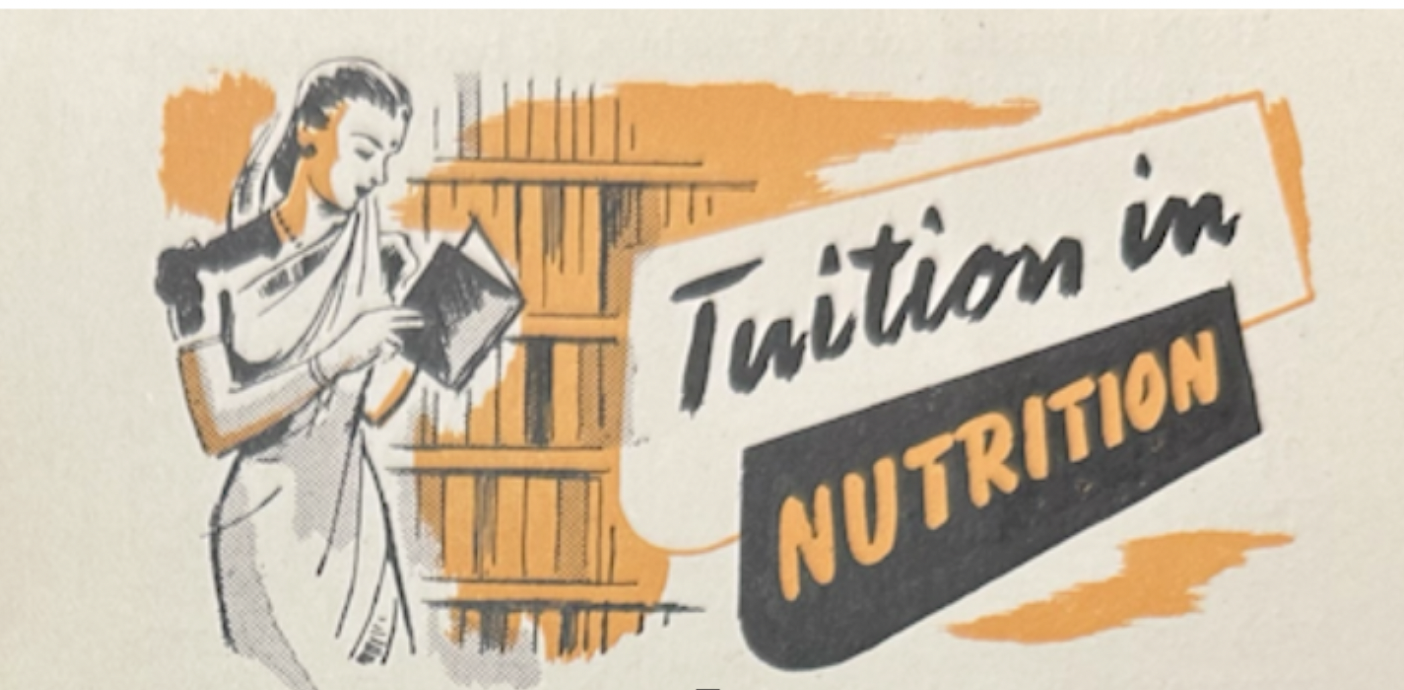
In a decade marked by existential fears and mounting anxiety around food scarcity, disease, and high mortality, the character of Food and Nutrition appears disarmingly innocuous. Its stated aim was to ensure ‘more and better food for the people without waste’, signalling a food policy that combined ‘Grow More Food’ with the ‘Miss a Meal’ programme of the early 1950s.4 Sold through leading booksellers, newsagents and railway bookstalls and with a circulation of 10,000, these bright and colourful booklets of thirty-odd pages each are full of illustrations, tongue-in-cheek cartoons, and overly earnest articles recommending neat tips and tidy tricks for homemakers while in the same breath alluding to starvation deaths and epidemics in various parts of the country. Sample a few snappy titles of the bulletin’s recurring series—‘Tuition in Nutrition’ (offering an outline for a course on nutrition science), ‘On the Kitchen Front’ (advice for the female homemaker), ‘Food Notes and News’ (food-related tidbits from across the country), and ‘Talking Points’ (often including new discoveries in nutrition science). A Nutrition Quiz had questions that should not have tested this reader (Q: ‘Do vitamins in canned food deteriorate because of the darkness in the can?’)5 and ones that also left her stumped (‘The doctor feels it, the consumer eats it and it is rich in protein—What is it?’).6

We may now live in a world obsessed with counting calories, but in the 1940s, nutrition education based on balanced diets and calorific and vitamin requirements as a public health measure was in its incipient stages. Yet, the traction it had gained during wartime was here to stay. Food and Nutrition often reproduced or drew inspiration from publications by the United States Government (including a periodical that was also titled Nutrition) and the Welfare Food Service of Great Britain. Interestingly, it published articles only in English, but these were allowed to be reprinted in any Indian language.
The self-professed idea behind these didactic bulletins was that schools, welfare centres, canteens, nutrition committees, and Food Advisory Councils would draw on the knowledge imparted in these volumes. However, even a superficial reading reveals that the audience was neither as nebulous nor as gender-neutral as this description suggested—the bulletin was implicitly targeted at a primarily female audience of homemakers, nutritionists, teachers, and practitioners who were expected to be at the helm of these committees and councils. The government was enlisting women as its agents on the Food Front.

The macro elements of the government’s food and welfare policy, especially rationing and the public distribution system, have been analysed by a handful of historians, but what sets Food and Nutrition apart is its focus on the individual homemaker and the household. Here was an explicit centering of female agency. At the same time, Food and Nutrition upheld a biopolitics that rested on the patriarchal assumption of a naturalized link between home, kitchen, and woman—reinforcing her duty to nourish her husband, the worker, and her children, the nation’s future citizens. If vision built empires, as one issue proclaimed, Food and Nutrition would build a nation.
Planning for Plenty

The oft-repeated rhetoric of planning filtered down to the level of the household, with Food and Nutrition issuing a strict injunction to its homemaker readers that they must use their wisdom and ingenuity to utilise limited budgets in such a way that they could feed their families and avoid disease and ill health at a time of food scarcity. The ‘job needed of her most’ was her ability to plan food based on her knowledge of the ‘right foods for the best health of herself and her family[original emphasis]’. A December 1947 edition declared: ‘Today it is our DUTY to keep well, buy carefully, waste nothing. Here are the rules. It is the WOMAN’S JOB to know and use them NOW.’ Dietary needs had to be tailored to each member of the family based on whether one was a home-maker, industrial worker, farmer, office worker, or child. To encourage their children to develop healthy food habits, mothers should serve meals in two or three courses with ‘each one being a surprise’. In March 1947, a five-day Food and Nutrition Exhibition was held at the Willingdon Cricket Pavilion in Delhi, with admission restricted to women on its final day.7
Twenty-first century nutritionists would balk at some of the advice, but much of it reflected the medical knowledge of the time. Exhorting readers to ‘Eat more Potatoes’, hailing them as important energy foods with protein and vitamins, its cultivation per acre offering more calories than rice or wheat, has certainly had a long-lasting impact on Indian dietary habits. A particularly amusing article ‘Do you lack sugar?’ instructed readers to ‘imbibe a meethee temperament’, claiming that low blood sugar was the major cause of antisocial activity and goondaism in India. ‘Cruel parents, delinquent children, overbearing masters and rude servants…traffic violators, overbearing overseers and cruel warders’ could all be cured with a bit of shakkar.
Educated women were expected to play a key role in sharing nutrition knowhow, not only through conversations with their friends and neighbours but also in a professionalised way by acquiring training in nutrition science. ‘Tuition in Nutrition’ laid out directions for a course aimed at providing low-income groups with limited education and ‘simple, workable knowledge’ of good nutrition. In this, both text and accompanying illustrations are clear—that it is the women who teach and the women who learn. At the same time, the scientists who were developing nutrition research and the people sitting around conference tables at the FAO or government bodies—the decision-makers—were always depicted as male.

Elite and lower-income women had vastly different encounters with food. Food and Nutrition’s conceptualisation of an ideal domestic model was based on a tiny minority of elite women who had a retinue of domestic staff—homemakers who supervised rather than carried out the actual labour of cleaning and cooking. Although working-class women performed the physical labour of food preparation and used their ingenuity to sustain entire families with minimal rations, they were considered most in need of nutrition education. The Anglophone elite positioned themselves as educators and supervisors, despite lacking practical knowledge of ground realities, the ability to relate to the pressures of economising, or any understanding of the kinds of foods a labouring family required for daily sustenance. There was a fundamental conceit in the elite’s claim to lead by example, one that continues to afflict exchanges between South Asian women across socio-economic strata. Nonetheless, women were excluded not only from laying claim to knowledge production in nutrition science but also from decision-making about food programmes—both of which remained male-dominated. The hierarchy was clear—if women were soldiers on the Food Front, then men occupied the commanding ranks, directing policies and claiming expertise.
Caste was referenced only obliquely in the bulletin, but the sheer absurdity of some of Food and Nutrition’s injunctions starkly highlights how socio-economic precarity had deeply fractured access to food. One issue urged its reader to do away with ‘age old ideas of pollution’ and allow their servants to eat leftovers. Another instructed the ‘modern housewife’ to keep a close and watchful eye on her servants’ and her cooks’ sense of hygiene—with repeated references to their lack of sanitary habits, a tendency of ‘sneezing and covering the food with a dangerous shower bath’, and being ‘practically in a bath of sweat all the time’. To discourage wastage, one bulletin urged —‘Can we not entertain a bit less?’—for these were ‘days of scarcity and by entertaining less you are certainly helping to hold the Kitchen Front.’ The assumption was that whatever the affluent saved would increase food circulation within the system, ultimately reaching those in desperate need.

The gulf between this imaginary audience and the real experiences of Indian citizens only kept expanding. In February 1947, Prasad admitted there was a ‘great deal of underfeeding’. Large numbers of malnourished people were succumbing to diseases in Madras, where district collectors were instructed to use their rations cards to draw foodgrains on their behalf and provide them cooked meals. Various measures to prevent famine were being announced and tested, and school feeding programmes provided mid-day meals for lower-caste students. Considering that children who had access to schooling at this time would have possessed a certain degree of socio-economic capital, this indicates that the struggle extended beyond the lowest income demographics. Partition refugees in camps were facing destitution and malnourishment, unable to meet even minimum calorie requirements until the government revised their daily allowances up to 284 grams of wheat or atta along with 340 grams of vegetables, dal, oil, salt, condiments, and sugar. The quantification of calorie targets became a key part of government food policy.

Counting Calories
During the Bengal Famine, the gruel that was served in relief kitchens accounted for only about 800 calories. Through the mid-1940s, several diet surveys had been conducted across industries to assess the quality and quantity of workers’ food intake. Under the wartime colonial government, a diet calibrated to a 2600-3200 calorie goal and adjusted to the limited food available was provided to workers in essential industries, albeit with a lower entitlement for women workers.8 This was a life-saving policy, but one that was only selectively extended to those workers who were deemed important for ‘productivity’. The colonial state and capital had a narrow understanding of ‘productive’ workers as those primarily serving a global market, engaged in heavy industry and the manufacture of consumer goods (like cloth and tea). The postcolonial government incorporated the male agricultural worker into this definition. Against this backdrop, Food and Nutrition is a fascinating yet disturbing insight into the biopolitics of nation-feeding.

Women’s potential for productive labour was marginalised from these discussions, which focused more on their reproductive power—reinforcing a patriarchal and historically contingent demarcation of gendered responsibilities in serving the nation. If male workers performed the duty of economic production, women were assigned the labour of social reproduction. This artificial separation—informed by the intersection of South Asian upper-caste prescriptions with Western gender norms—reflected a profoundly inadequate and dangerous understanding of a complex reality. A large proportion of Indian women worked outside their homes in agricultural labour and as workers in industries, plantations, mines, and construction, often on an informal basis and for very poor pay. They worked a double shift—as breadwinners and breadgivers—but this was rarely acknowledged in government food policy. Women’s calorific entitlements were consistently and notably poorer than those for men. A diagram in a May 1948 issue was unambiguous in this respect. If the man behind the plough required the highest calories (3,500 daily), it was the expectant and nursing mothers who required the highest protein content (101-112 grams daily). Between childhood and adulthood, a female citizen’s trajectory was expected to transition from skipping rope to a sedentary lifestyle, except for the times when she was an expectant or nursing mother. This reinforced the long-term pattern of invisibilizing labouring women. Women who disrupted the nationalist ideal of middle-class domesticity—heavily influenced by the Western male breadwinner/female homemaker model—came to be cast as anomalies when they were much more numerous than assumed. Food and Nutrition ignored the needs of many women who were leading very physically active lives and working in arduous labour but it did acknowledge the strenuous work involved in maintaining a home and feeding a family. However, in urging its homemaker readers to care for themselves, it maintained that her well-being was essential insofar as it enabled her to better serve her family and the nation’s future citizens. It was her duty to ‘Build Bonny Babies’. The intergenerational consequences of this systemic and structural neglect could not be more stark. Female deprivation has led to incredibly poor health outcomes, particularly among communities living in poverty.9
Making Home and the Nation
Food and Nutrition was firm in its conviction that prudent and modest consumption—planning the week’s menu well in advance, skipping a meal, or saving carrot tops—were small actions that could have a great impact. As bizarre an expression of the Food Front as it may have been, it offers valuable insights into how the early postcolonial state understood and constructed the roles and duties of women citizens. It entrusted them with the crucial responsibility of feeding while relegating them to the lowest tier in the hierarchy of eating. A tuition in nutrition offered little solace when a significant portion of the population could not even afford the bare minimum for survival. It is no wonder that the bulletin faded into obscurity. Behind every provocative cartoon, punchy title, and a bit of stylistic flair lay the stark and overwhelming reality of a newly independent nation where millions of its citizens were starving, destitute, and intensely vulnerable to disease. Food and Nutrition is ultimately a narration of hunger told through a blinkered pen.
Urvi Khaitan is a historian and currently a Prize Fellow at the Center for History and Economics, Harvard University.
- Benjamin Siegel, Hungry Nation: Food, Famine, and the Making of Modern India (Cambridge, 2018).
↩︎ - W.G. Aykroyd, ‘Public Health and Nutrition in India’ in War Food Administration, US Department of Agriculture, A Brief Review of Food and Nutrition in Five Countries (Washington DC, January 1944), pp. 23-24. ↩︎
- Sunil Amrith, ‘Food and Welfare in India, c. 1900–1950’, Comparative Studies in Society and History, 50/4, pp. 1010-1035. ↩︎
- Taylor C. Sherman, ‘From ‘Grow More Food’ to ‘Miss a Meal’: Hunger, Development and the Limits of Post-Colonial Nationalism in India, 1947–1957,’ South Asia: Journal of South Asian Studies, 36/4, pp. 571–588. ↩︎
- No, darkness actually helps in preservation. ↩︎
- A pulse! ↩︎
- Government of India, ‘Food and Nutrition Exhibition – Brief Outline’, Ministry of Home Affairs – Public, National Archives of India, File No. 157/47-PUBLIC. ↩︎
- Urvi Khaitan, ‘A Tepid Cup of Tea: Gender and the Household Economy in Northeast Indian Plantations’, The Journal of Imperial and Commonwealth History, 52/6 (2024), pp. 1032–1062.
↩︎ - Siddiq Osmani and Sen, ‘The Hidden Penalties of Gender Inequality: Fetal Origins of Ill- Health’, Economics and Human Biology, 1 (2003). ↩︎
 Lokayata
This is fascinating and touches one’s heart. Thanks for the enlightenment, golden Sunday reading in my place of plenty. 🍛
LikeLike
Such a fascinating analysis and insight into the roles the colonization and culture of food played in the oppression of women. I will try to contact the author for an interview.
LikeLike
Dear Urvi Khaitan,I would Ike to establish contact with you as author of this article. Perhaps we count talk
LikeLike