
January 2022
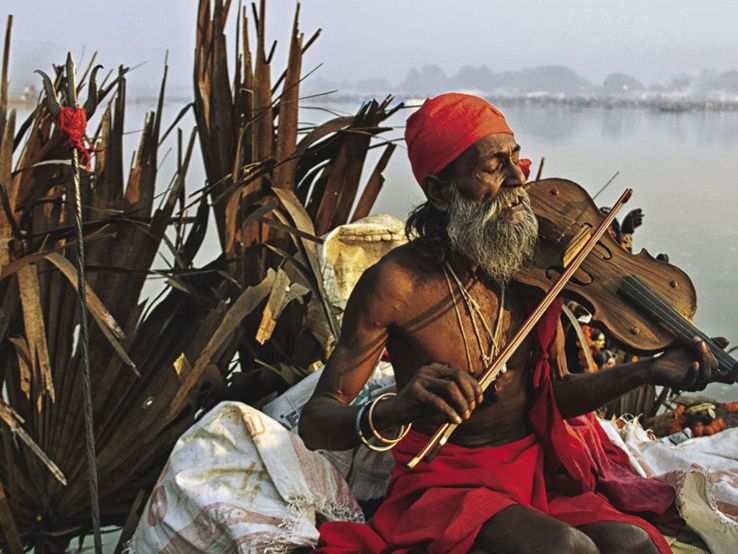
As the first light of dawn caressed the tranquil waters of the Ajay River, the world seemed to hold its breath in anticipation. A soft, golden glow spread across the horizon, gently nudging awake the sleepy village of Jaydev Kenduli (hereafter, Jaydev) nestled on its banks. The sky, a canvas of soft pastels, gradually gave way to the fiery hues of the rising sun, casting a warm glow on the bustling banks of the river. The morning air, crisp and fragrant with the scent of dewy grass and blooming marigolds, was filled with the promise of a day unlike any other. The river, usually serene and solitary, was now alive with the mad excitement of preparation.
Today was the day of the famous Jaydev Baul Mela, a celebration that had drawn people from far and wide for decades. Colourful tents sprung up like mushrooms after the rain, each a miniature world of its own. The scene was a harmonious chaos. Vendors hurried to set up their stalls, their voices mingling with birdcall and the soft murmur of the flowing river. Families, Baul-Fakir performers, musicians, and cultural enthusiasts from across West Bengal, with their faces alight with excitement, bustled in every direction. From the nearby villages, people arrived in waves, their silhouettes growing distinct against the brightening sky. In their most vibrant outfits, women and men alike carried baskets of grains, lentils, and vegetables, children clutched their parents’ hands with wide-eyed anticipation, and elders walked with their faces lit with the glow of nostalgia and expectation. They came on foot, by bus and train, and even on bicycles.
The hustle and bustle grew by the minute. The distant sound of a call-and-response between dotārā and dubki, the melodic high notes of flutes and anandalahari floated through the air, mingled with the chatter and laughter of families and friends. The dense cumulus of cannabis smoke curled upwards and mingled with the scent of frying samosas and jalebis, and brewing ginger chai wafted through the air promising further gastronomic delights. It felt like a thrumming pulse of humanity converging on this spot of earth. As the morning sun ascended, it cast a warm, golden hue over the banks of Ajay. The melā had begun with a riot of colour and sound that roused the serene riverside to life.
Melā means a fair where people assemble to exchange ideas, buy and sell things, and often serves as a meeting point for friends and relatives from neighbouring villages. Jaydev Baul Mela is a pompous annual carnival construed in the form of a ritual bath, accompanied by immersive performances by Baul-Fakirs and communal feasts. The village is popularly believed to be the birthplace of the celebrated Sanskrit poet, Kavi Jaydev. Jaydev was the court poet of Raja Lakshman Sen who ruled over the Bengal delta in the 12th-13th century CE. The purpose of my visit was to attend the annual Jaydev Kenduli Baul Mela held during the auspicious occasion of Makar or Poush Sankranti marking the end of Poush, the tenth month of the Bangabda calendar. Even though the day selected is auspicious according to Hindu tradition, it constitutes a great irony that the ritual actions during the melā have historically been a critique of the hierarchical social orders and institutionalised religions in general.
According to the local myth, while composing Gitagovindam, a classic Sanskrit text which celebrates Radha as the primal śakti (source of power), even greater than Krishna, Jaydev faced a ‘poet’s block’ at a particular ‘pada’ (Sanskrit poetic meter) in which he wanted to make Krishna hold Radha’s feet (a gesture of respect for elders in Hindu tradition. He wanted to show even God or his Avatara (reincarnations) is a dasa or slave of his devotee (which would conventionally be considered sacrilege), but could not do that out of hesitation. He wondered how Krishna ⸻ the Lord of the World ⸻ could hold the feet of his secret lover?
Constantly failing to poetically render this scene, he decided to leave the composition aside for the time being and went on to take a dip in the Ajay River. After the bath, Jaydev returned to his hut in haste and said to his wife Padmavati that the pada (verse) had flashed before his eyes and he had to write it down immediately before it faded away. He wrote:
smara-garala-khaṇḍanaṁ mama śirasi maṇḍanaṁ
dehi pāda-pallavam udāram
which roughly translates to ‘Please place your foot on my head, as a sublime blossom that can destroy the poison of the sufferings of love.’

Probably that is why this three-day mela is organised around a ritual bath in River Ajay, which takes place on the first day. Nevertheless, the major attraction for me was the āsara (musical congregation) in the ākhrās (common meeting places where ideas are exchanged) where the Bauls-Fakirs and Kirtaniyas (those who sing Kirtan, a genre of Bānglā Bhakti songs performed by Vaiṣnavas) from across the state had assembled. As I walked towards one of the āsaras, I could hear a very familiar prelude in dotārā of a famous Lālan Geeti (a canon of Bangla folk songs composed by a Fakir mystic and philosopher, Lālan Shāh) as one of the young performers dressed in a bright orange robe and headdress started to sing this all-time classic:
Jāt gelo jāt gelo bale/ Eki ājab kārkhānā
(Caste is lost, caste is lost! What a cacophony all around!)
Satya kāje keu nāi rāzi / Sab-e dekhi tā nā nā nā…
(None is ready to traverse the path of truth. All I see is the bickering over ‘yes’ or ‘no’.)
Āsbār kāl-e ki jāt chile? / Ese tumi ki jāt nile?
(What caste were you when you came to this world? What caste were you after you were born?)
Ki jāt hobā jābār kāl-e? / Se kathā bhebe bala nā
(What caste will you be while departing? Why don’t you reflect on this?)
This full-blown attack on caste hierarchies and by extension, strict ritual precepts and authorised scriptures of all orthodoxies of institutionalised religions — especially Hinduism and Islam — constitute a central theme in Lālan’s songs. They revere mānuṣ (human beings) at the here-now (bartamān), instead of idolatrous worship which is integral to their non-dual (advaita) spiritual praxis. Hence, they reject divisive social categories like caste, religion, gender, sect, etc. as anumān (hearsay, inference) expressing their humanitarian and egalitarian worldview through these songs-in-performances. The rejection of anumān (worship of God with or without form, authority of orthodox scriptures and ritual prescriptions, and inferred, invisible cosmic “realities”) is not merely a spiritual stance but also a profound political declaration against the hierarchies and inequalities perpetuated by caste structures.
A (former “low-born” Hindu) initiate from Nadia, once very casually told me: “You know, the purohits (priests) never let us Śūdras enter the temple, or read the Bed-Qorān (pre-eminent religious scriptures). Now I refuse to abide by them. My body has become Bed (Vedas).” This anti-structural resistance is intricately related to the way the Almighty has been franchised into a members-only club with strict religious and moral codes by the landowning upper-castes, where God’s hotline through worship is only accessible to the “ritually high” clergymen. Interestingly, songs about deha-sādhanā (body-centred spiritual practice) often use sandhyā-bhāṣā (intentional, or ‘twilight’ language) to conceal esoteric/inner meanings from outsiders/non-initiates, but those critiquing the structural hierarchies and inequalities in conventional religious practices (e.g. caste, sect, and gender discrimination) are entirely transparent.
As I moved around the melā for the next two days, I had the opportunity to interact with people from faraway villages, from various walks of life. I had numerous conversations with the pilgrims who gathered for the ritual bath, immersive performances, and the communal feast at Jaydev. One of those conversations was with Pranonath Mandal, an agriculturist from a neighbouring village of Raghunathpur, who brought along with him a bagful of rice and fresh vegetables (cauliflowers, aubergines, potatoes, and bottle gourds) as his contribution to the communal feast. He proudly asserts,
Bābu, all these are homegrown. This year, I have grown cucumbers and carrots too. I will get those for tomorrow’s feast. I bet you will not find more fresh vegetables anywhere, even in Kolkata. All the vegetables you buy from your shopping malls are just soaked in chemicals. I use nothing but organic compost, hence my vegetables taste even better.
Without any further provocation, he adds,
I am a poor farmer dwelling on 2.5 bighā (roughly equivalent to 0.62 acres) of agricultural land. And I have five bellies to feed throughout the year. Everything we grow on this land is used for our subsistence.
I could not resist from asking, “Then, why did you get all this harvest for the feast? Should not you have saved those for your family?”
He smiled and said, I have been coming here since I was a child. Every year, I come here to take a dip in the Ajay River on the occasion of Poush Sankranti which I believe helps me annihilate my ahamkār (ego). To integrate ourselves with each other, all of us feel obliged to bring whatever we can for the feast. Everyone becomes one when they share the prasāda (food prepared for pilgrims at the community feast) cumulatively made from all the harvest people pool in specially for the feast voluntarily. It does not matter who you are. Everyone here is the same — a human being.
I was bereft of words.
Bidding goodbye to Pranonath, I started looking for Sahidul, an eminent Fakir practitioner and my teacher whom I first met at his resident village, Gorbhanga in the Nadia District of West Bengal the previous year. It was, in fact, Sahidul who first mela to me and invited me to join. I found him sitting at one of the ākhrās surrounded by his disciples. Upon seeing me, he called me close and made me sit beside him. When the tired disciples briefly halted their singing and playing, I took the opportunity to ask Sahidul himself about the significance of these ritual actions which were characteristic of the melā. Sensing my overflowing curiosity and willingness to make sense of all of this, he generously agreed to show me around the carnival premises and tell me the underlying context associated with each ritual.
He first led me to a corner in the ground where ‘mālsā’ (a communal drink made of fresh sugarcane and/or lemon juice mixed with cold water) was being prepared in five to six large earthen pots by several attendees under the watchful supervision of Gour, a Baul practitioner from Birbhum. Sahidul and Gour exchanged greetings as they both bowed down on their knees facing each other as a sign of mutual humility. Sahidul introduced me to him and said, “This boy has come from Delhi. He seems to be very interested in the rituals of our melā. Why don’t you tell him more about mālsā?” Gour seemed to be elated by this proposition. To prove your competency in Baul philosophy in front of a senior Fakir is undoubtedly a tempting opportunity that Gour desperately wanted to seize. After a brief pause and a deep exhale, he dramatically looked into my eyes and asked, “Do you have caste?” Such an abrupt question took me aback despite knowing the answer very well. My momentary hesitance was probably what Gour was anticipating in response.
With a smile full of compassion, he goes on to say, “You do not have to tell me. Mālsā has the inherent ability to figure out whether you have caste.” He continued,
Once it is prepared and distributed among groups, all attendees in each group will sit in a circle and drink from a ghoti (small earthen pot) and pass it on to the person to your right. If anybody refuses to drink from the same pot, it would be safely inferred that they believe in caste and would be requested respectfully to leave the congregation.
Sahidul later explained to me that the same rationale prevails in the idea of a community feast where everyone pools in something and shares the meal, while smoking chillam (a cone-shaped earthen pipe) everyone is expected to bring some cannabis as an offering to their respective spiritual gurus and then the guru is expected to prepare the chillam and pass it around as prasāda among the assembled disciples sitting in a circle. It is clear that the disciples are not excluded from these performances, rather they form an integral role actively participating in their construction.
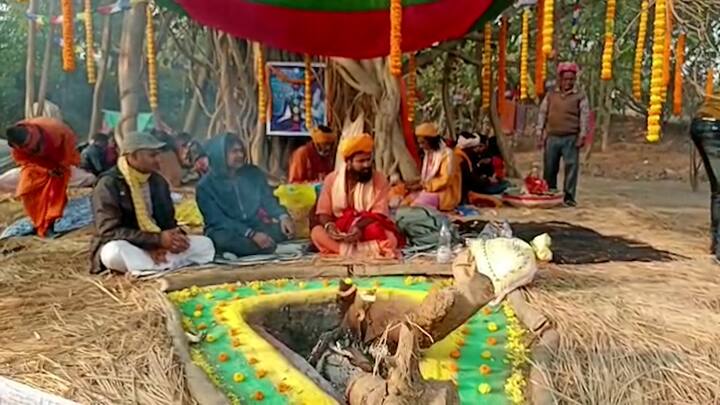
Besides the ritual bath and sharing meals and chillam, this is accomplished by singing songs of fraternity which resonate with the common people both because of their rich philosophical ideas and the immersive nature of these performances. The Baul-Fakir mystics along with their disciples sing to break down the narrow walls of communal segregation, and their music becomes a medium for their spiritual expression — conveying their ideas of social reform — from syncretism to egalitarianism. These expressions of ‘simple living and high thinking’, as resistance to hierarchical institutionalised religions, transform into reality by subjecting the body to formalised actions — the ritual bath at River Ajay, contributing to the communal feast, sharing the chillam, the feast and mālsā to annihilate their ego and nurture human indivisibility.
The bringing together of individuals as mānuṣ (human beings) at the melā is achieved through the deeply embodied and performative dimensions of communal rituals and shared practices which create a collective experience where all are equal. The communal feast, as exemplified by Pranonath’s offering of his homegrown harvest, becomes a powerful symbol of collective participation regardless of social status, where the voluntary pooling of resources — be it food, song, or labour — dissolves social and economic distinctions. Sharing the prasāda, prepared from the contributions of all attendees, allows individuals to transcend their personal identities, fostering a sense of unity and belonging through commensality. The ritual of drinking mālsā from a communal earthen pot underscores this process of integration by challenging caste distinctions.
Music, integral to the Baul-Fakir mystic traditions, plays a central role in this process. Songs of fraternity, with their rich philosophical underpinnings, invite listeners to engage emotionally, reinforcing the themes of social reform, syncretism, and egalitarianism. These performances not only immerse the audience in shared expressions but also create a collective emotional atmosphere (pathos). By chorusing these songs, participants’ divided attentions converge, embodying the unity that the melā seeks to achieve. Thus, the ritual actions, musical performances, and communal practices work in tandem to break down walls of segregation, uniting all as one in a profound, experiential demonstration of shared humanity.
What is interesting is that the efficacy of the ritual actions at the Jaydev Mela is not unambiguous to the attendees but is socially constructed by the performers and the participants together. The realisation of this reality is not just embodied in collective performance, but also emerges from the interaction between all the Baul-Fakirs and the attendees present. These songs not only form the lifeblood of the Baul-Fakir tradition, but have also provided refuge and community to the ostracised and the marginalised. As a result, these songs have become an integral part of the everyday lives and culture of people in rural Bengal. The songs which advocate and harness a common identity as human beings which Lālan described as ‘mānuṣtatva’ drew inspiration from a range of religious ideologies like Hinduism, Islam, Buddhism, Tantric practises and from reformation movements triggered by the Bhakti and the Sufi orders. Despite this inherent syncretism, the shared energy among the mystics and pilgrims is what provides a unity of purpose and is a palpable, living force — an embodied rhythm that pulsates through every participant, weaving among them a collective consciousness.
It is not merely experienced but felt in the most visceral way, as the community engages in acts of shared vulnerability and connection. This energy transcends the boundaries of individual ego and social divisions, flowing freely between bodies, voices, and actions. Each participant becomes a vessel of this collective force. This energy is thus a binding current — intangible yet unmistakable — experienced in the synchronised rhythms of feet moving together, voices rising in unison, and the tactile passing of the chillam or communal drink. It is a force that moves not just through the physical space of the melā but through the hearts and spirits of all present, forging a sense of oneness. In this space, the rituals act as catalysts, amplifying this feeling of togetherness, transforming individual experience into a shared embodiment of compassion, fraternity, and interconnectedness. It is this living, breathing energy that turns the melā from a mere gathering into a profound enactment of human indivisibility, where every gesture, every breath, is part of a larger, unified symphony of existence.
Note: All names of my interlocutors have been pseudonymized.
 Lokayata