

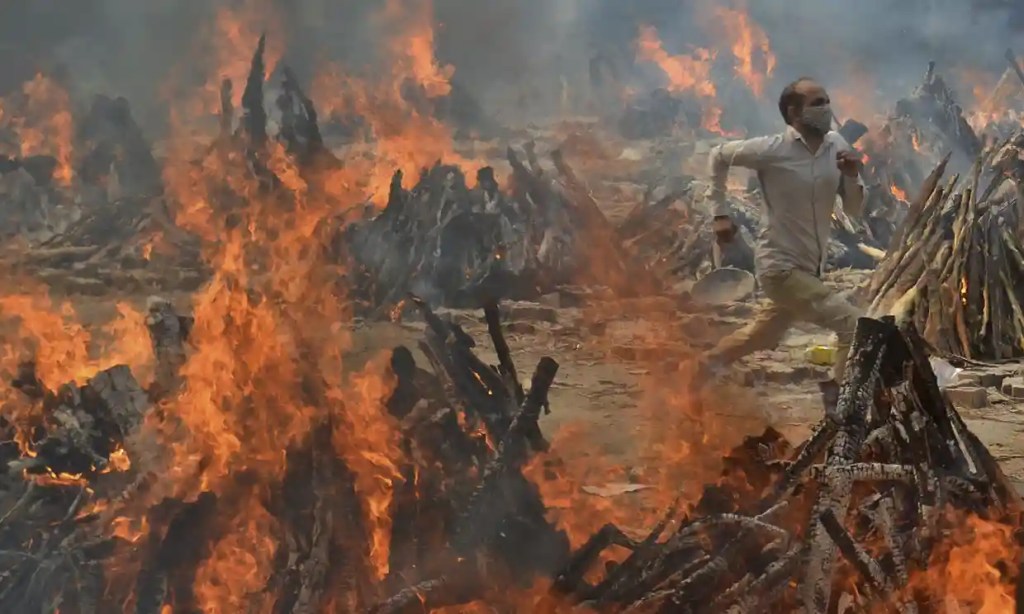
[Translator’s Note: I had first read this short story by Yashpal in 2014, and it was through it that I learnt that sorrow and grief, which I understood as undesirable, as emotions to be avoided, were in fact a need. A need that not everyone was provided with the means to fulfil. The idea of seeing grief as a right was so new that it left an indelible mark on me. I started translating the story in 2020, during the pandemic, when death and its fear was omnipresent. I could not complete it then. The anxious atmosphere due to the suddenly imposed lockdown did not allow me to. Fear and uncertainty had mixed with helplessness and guilt at feeling limited in helping those whose experiences were far worse.
The rising number of COVID cases every day intensified the fear in those who did not lose themselves in the mounting statistics. These numbers also became a way of calculating the possibility of the world returning to normal, in order to sustain a flickering hope. However, these numbers concealed the unrecorded deaths of people whom the system had failed to provide medical care. They also did not account for the deaths that were caused not by the virus but by the lack of means for survival. The widespread misinformation and the unavailability of adequate infrastructure had everyone – the infected, the afraid and the dead – in its clutches, but the numbers failed to reveal that not all deaths are the same and neither are their aftermaths.
‘Dukh ka Adhikar’ portrays the struggle of a mother following the untimely death of her young son. The story shows how the urgency of survival for the underprivileged is made more difficult by the norms and codes of the upper castes and classes. Yashpal provokes one to reflect on the material consequences of death, rather than its abstract religious connotations. He carefully lays out details to critique the ritualistic paraphernalia surrounding death, which seem to profit the Bajajs and Lalajis of the town, the same upper-caste people whose understanding of the mother’s situation is limited by their ruthless appraisal of her actions. The story highlights the discrepancy in the treatment of death and the ability to mourn it across different classes. This piece was supposed to be finished and published sometime in the pandemic, as a reflection on the disparities within our collective experience of a difficult period. However, it is being brought out now, in an attempt to remember that time. We are still unsure about the ways in which we could remember and mourn, let alone faithfully document the enormity of the pain and loss that people suffered then and the multiple possibilities of life that were erased.]
The clothes people wear divide them into various categories. Often, clothes determine the rights and the status of human beings in society. They open multiple shut doors for us, but sometimes there comes a situation in which one wants to bend down a little to understand the experience of the lower strata of society. At that time, these very clothes become restraints and obstacles. Like the waves of wind that do not let a loose kite fall straight to the ground, in specific circumstances our clothes prevent us from bending down.
In the bazaar, some melons were kept in a basket and some upon the ground for sale on the footpath. Near the melons sat a middle-aged woman, crying. The melons were for sale, but how could anyone have gone ahead to buy them? The seller of the melons, with her head on her knees and her face hidden behind a cloth, was sobbing bitterly.
The people sitting on the seats of neighbouring shops or standing in the bazaar were talking with disgust about this woman. My heart felt a little sore on seeing this woman cry, but what was the way to learn the reason for her crying? My clothes only stood as a hurdle in me sitting beside her on the footpath.
Spitting on the side with disgust, a man remarked “What an age! It hasn’t been a single day since her young son died, and this brazen woman has set up shop.”
A second gentleman, scratching his beard, said “I say, as is someone’s character, so is the fortune Allah gives them.”
Screwing a matchstick in his ear, a man standing on the opposite footpath, said, “Well, how does it matter to these people? These rascals can give their lives for a piece of roti. Son-daughter, husband-wife, faith-belief are all a piece of bread for them.”
Sitting in his grocery shop, Lalaji said, “Listen brother, even if death and life mean nothing to them, they should at least consider others’ faith and belief! There is a thirteen-day sutak[1] when a young son dies, yet she has come here to the bazaar and sat down on the street to sell melons. A thousand people come and go. What does anyone know of the sutak in her house? If someone were to eat her melons, then what would remain of their faith? What darkness!”

On asking at shops in the neighbourhood, I learned that she had a young boy of twenty-three years. Her daughter-in-law and grandchildren are still in the house. The boy used to provide sustenance to his family by cultivating a small piece of land near the town. Having delivered the basket of melons to the market, sometimes he would sit for the sale himself and sometimes the mother would.
The day before yesterday, the boy was picking ripened melons from vines in the early morning. While he was resting on a bund of wet earth, his foot hit a snake. And the snake bit the boy.
The boy’s old mother went into a frenzy and called a shaman. He performed the tricks of his trade. The lord of serpents was worshipped. The ceremony requires ritual offerings and fees. Whatever flour and grain there was in the house was all used up in paying for it. Mother, wife, and children, all clung to Bhagwana, kept crying, but once Bhagwana fell silent, he did not speak again. His entire body had turned black from the snake’s venom.
A living man can even stay naked, but how does one bid farewell to an unclad dead? One has to buy a new cloth for him from the Bajaj’s shop, even if it means selling the bangles and bracelet from the mother’s hands.
Bhagwana left for heaven. Whatever husk and rusk there was in the house got exhausted in sending him away. So what if the father was no more, the boys, as soon as they woke up, started bawling from hunger. The grandmother gave them melons to eat, but what would she have given her daughter-in-law? The daughter-in-law’s body was burning from fever like a hot pan. Now, without a son, who would have lent her even two or three annas?
Weeping, and wiping her eyes, the old woman put the melons collected by Bhagwana in her basket and started towards the market—What other choice did she have?
The old woman had summoned the courage to come and sell melons, but, covering her head with a sheet, resting it against her knees, she kept sobbing bitterly.
She, who lost her son yesterday, has come to the bazaar today to make a sale. What a stone-hearted woman!
To understand the grief of this son-bereft mother, I started thinking of a mother in my neighbourhood, who was mourning her son’s death last year. That disoriented woman could not get up from her bed for two and a half months after her son’s demise. Every fifteen minutes she would faint from the pain of separation and, when she did not faint, tears would not stop trickling down her eyes. Two doctors were by her bedside at all times. Ice was always to be kept on her forehead. Across the town, people’s hearts melted at the tale of this mother’s mourning of her son.
When the mind does not find the path of reason, restlessness quickens one’s steps. In this state, with my nose held high, stumbling into other passers-by, I kept walking on. I was thinking…
To mourn, to even grieve one needs convenience and … to be sad is also a right.
[1] It is a religious practice requiring the family of the deceased to observe a period of isolation and refrain from worship. The idea is to contain the impurity that is believed to arise from the death or birth of a family member.
 Lokayata
One thought on “Yashpal’s ‘The Right to Grief’—Translated by Riya Lohia”