

The Tughlaqabad Fort, built around the 14th century, stands in ruins now, seven centuries later. What remains are the various settlements outside the fort enclosure. These settlements are equally old, built around the fort and inhabited by the working-class people ever since. While Ghiyasuddin Tughlaq might have found it difficult to populate the area inside the fort, the area around it is a bustling hub of the migrant population in Delhi now. Or so it was till a few weeks back. Anxiety, hopelessness and desolation run amok in the people who have found their homes in shambles. Their houses have been the target of a long-drawn legal battle culminating in a 2016 Supreme Court verdict directing the Archaeological Survey of India (ASI) to reclaim the spaces around heritage monuments which have been termed as ‘encroached lands’. Tughlaqabad village is one among many such settlements which have been earmarked for such demolition. The people living in clusters around Mehrauli, Kashmere Gate, and Mayur Vihar are also facing uncertainty about the spaces they have inhabited for years. These lands and houses have been termed as ‘illegal’ settlements by the state and its people have been painted as unlawful settlers contributing to the deteriorating condition of the historical sites around them. Their houses and settlements, however, are built a good few yards away from the enclosed boundary of the Tughlaqabad fort, with no visible signs of encroachment.
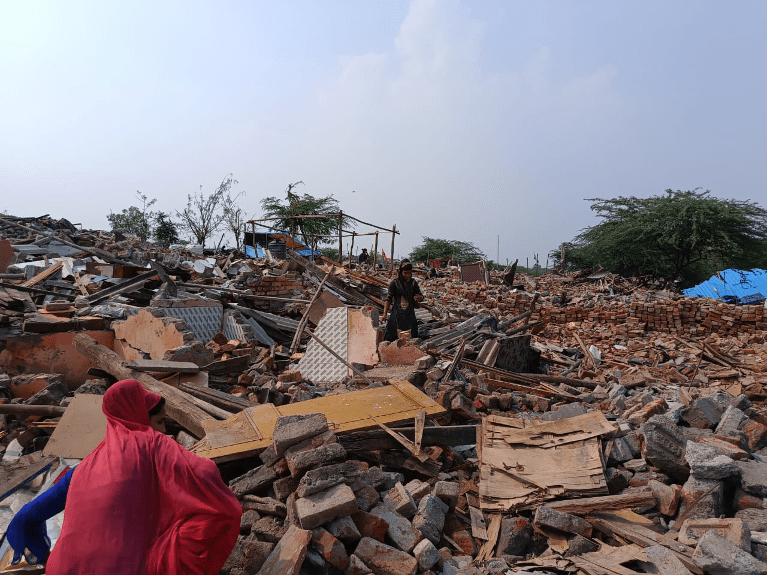
On entering the Tughlaqabad village, I encountered a post-apocalyptic scene straight out of a dystopian film. The entire area, as far as one could see, was covered with fallen concrete and bricks. This was the Chhuriya Mohalla, which was demolished entirely, without a forewarning on 30th April. The inhabitants of this locality have now been displaced and have lost their homes on which they had spent their meagre savings. While the Supreme Court and the Delhi Government had insisted that the ASI should find rehabilitation measures for these displaced people, nothing has been done so far in that respect. Sumana Roy, a domestic helper, implores that she had no clue that her house was set to be destroyed. She had rushed home from work on getting a call from her husband that bulldozers were in place for their house to be demolished. She found her entire establishment razed to the ground along with all their belongings buried deep within the rubble. This account is not an isolated one but is representative of the predicament of the inhabitants in general. While an ASI notice in January had been served ordering the inhabitants to vacate the place, the BJP MP Ramesh Bidhuri had assured them that no such demolition would take place. On the day of the demolition however, he was nowhere to be seen.
The Tughlaqabad village is populated by people from a variety of religious, linguistic and caste backgrounds, the working-class identity being their common marker. Most of them are migrant labourers dependant on the affluent neighbouring localities of Greater Kailash, C.R. Park and Nehru Place for their livelihood. While the state has termed their settlement as ‘illegal’, the residents claim to have bought the land and the houses they have been living in. Not only have the residents paid for the land, but also an amount of Rs. 10,000 per square feet extra to the local police station and the ASI officers when they built their dwellings. Shabnam (name changed on request) stated that she had to pay a figure of nearly 4 lakhs to the police and ASI officials combined, yet the police officials would frequently barge in and break parts of her house, threatening her to pay up more. The inhabitants have been registered voters holding Aadhar cards against their residential addresses in Tughlaqabad. They regularly paid electricity bills to the BSES with installment plans approved by the company. The boundaries between the spheres of legality and illegality become especially murky when people who were paying thousands to avail ‘legal’ electricity connection and water supply are displaced on grounds of ‘illegal’ encroachment.
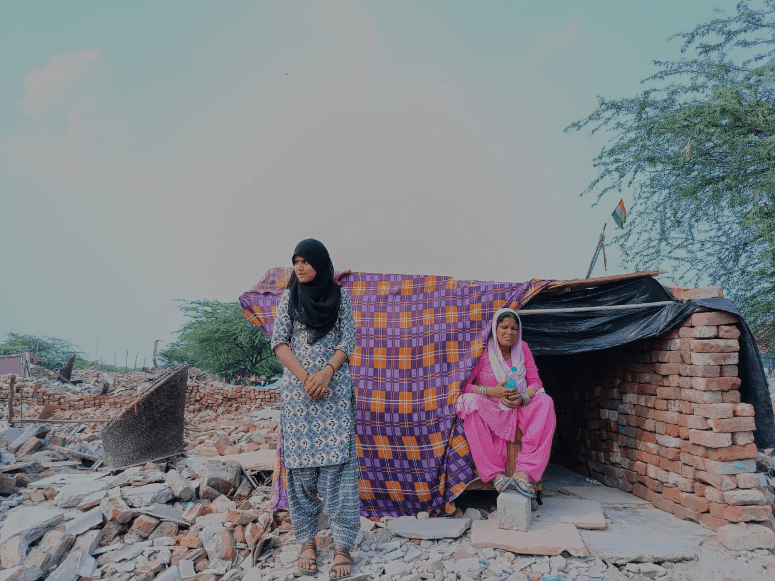
Beyond the financial cost entailed, there is also the aspect of emotional entanglement of the people with their homes. To simply think of people, especially those belonging to the lower socio-economic stratum, as numbered entries in statistics has long been the approach in technocratic capitalist economies, where such people could be simply picked off and resettled elsewhere without their consent. Priya Mondal, a resident who had her house demolished in Tughlaqabad, broke down recounting how the bulldozer breaking the floors and walls of her house felt as if it “hit her chest directly”. For the past one week, the people of the Chhuriya Mohalla have been living on top of the ruins of their homes, with no affordable housing available for renting, demarcating spaces by remembering and locating boundaries amidst ruins. Some have covered a particular heap of rubble with cloth, making a sort of tent, while others have dug trenches and taken shelter in them. Shabnam further explains how she was forced along with her family to take shelter inside the surrounding forest when rains poured constantly during the demolition. Families are seen desperately trying to dig through the broken concrete, in hopes of retrieving bedding, books, latrines and other possessions.
The greater context of ‘bulldozer justice’ being meted out to communities by the BJP regime is hardly a new one. Uttar Pradesh, Madhya Pradesh and more recently in Delhi, the state, backed by the BJP’s machinery, has been constantly targeting Muslim communities, lower class and lower caste migrant working populations by attacking their residential locales and driving them out of their homes. Notwithstanding a Stay Order issued by the Supreme Court in April 2022, bulldozers demolished buildings in the Muslim-dominated area of Jahangirpuri amidst slogans like ‘Jai Shree Ram’. The attack on the residents of Tughlaqabad fits into this picture as well. These settlements, or jhuggis as they are popularly called, have been sites of contestation between the Delhi Government, the Delhi Development Authority (DDA) and ASI, obfuscating and overriding the agency of the main stakeholders — the very people living there. Demolition of these settlements are also in line with the Union Government’s plan of hiding and shunning such ‘embarrassing’ localities anticipating the forthcoming G-20 summits that will host foreign dignitaries and diplomats. While Narendra Modi had announced under his flagship scheme, PM-UDAY, that every such ‘unauthorized’ or ‘encroached’ house would be converted into a permanent dwelling with a perfectly ‘legal’ status, this has never been realized. Instead, as the residents of Tughlaqabad allege, private companies such as CleanTech and Ventures AES partnered with the DDA to conduct partial surveys, collecting an amount of close to a thousand rupees from each family, peddling promises which have now turned out to be utterly false.
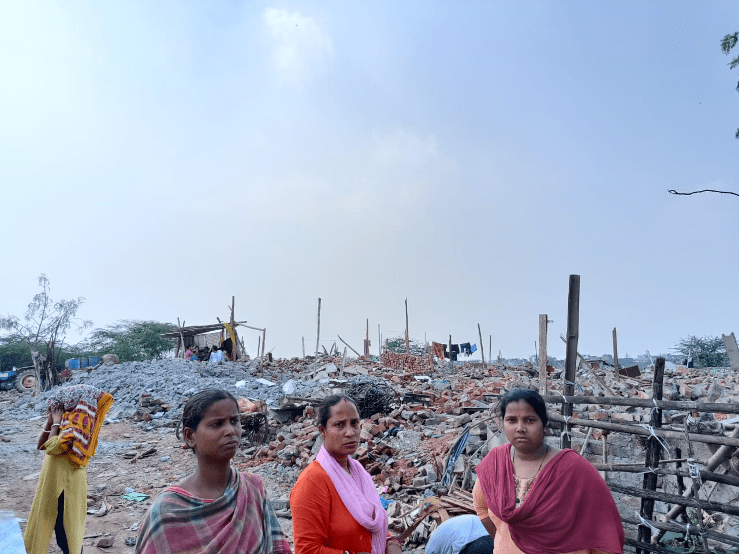
This, however, is not unprecedented. The Indian state has historically forced the Muslim community and the economically marginalized populace to live precariously in urban ghettos wherever they could. Not being able to access the ‘authorized’ and ‘legal’ spaces of their cities, Muslim and lower caste migrant workers have been mostly forced to seek shelter in such ‘unauthorized’ spaces, where they are uniquely vulnerable to the whims of the state and its rhetoric of development. Structural inequity creates and coerces spaces of ‘unauthorized colonies’ to develop. The ever-burgeoning apathy of the state and its upper-class and upper-caste constituencies who in turn are dependant on these working-class people for all kinds of domestic service, further reinforce the latter’s ‘illegitimate’, state-orphaned and invisibilized status. Mamta Mondal and Sabina, both domestic workers employed in C.R. Park, lament on losing their jobs during this period. Owing to their houses being demolished, and having to attend to such an emergency, they had informed their employers of not being able to join work for a few days. To their utter dismay, they were faced with complete disregard for their situations and were told to immediately rejoin work or lose their jobs. “Okhaner bari pore dekhbe, agey amar bari eshe kaaj kore jao” (You can worry about your house there later, first come and finish your work at my house), Mamta’s employer told her in a threatening manner.
The role of the ASI and its claim over the Tughlaqabad village, which has a well-settled populations there posits an interesting conundrum. While one does not fail to notice the convenient use of the narratives of ‘conservation’ and ‘preservation’ to unsettle marginalized people wherever applicable, the very use of terms like ‘conservation’ of ‘heritage sites’ and ‘reclaiming historically significant spaces’ makes it difficult to legally challenge the ASI-sponsored demolition. As an agency of the Union Government, however, it needs to be kept in mind that the ASI can be and is often deployed to serve the state’s purpose in a roundabout way. While historical memory is shaped and formalized by imperial and national institutions, historical amnesia always already embedded within it. In this particular instance, the official narrative is one about protecting the former imperial elite structures such as the Tughlaqabad fort. The people living around it, however, are earmarked only to be erased, displaced, and forgotten conveniently.
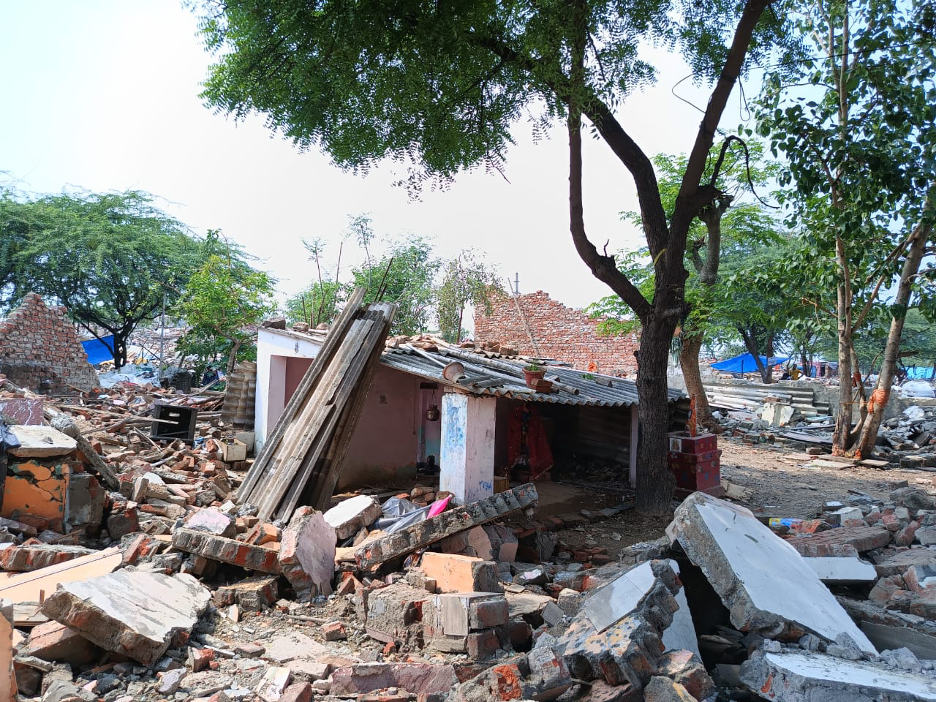
If historical memory is to be productively invoked, one only has to remember that in the aftermath of the 1947 Partition of the subcontinent, Delhi’s fort and monuments were opened up to house thousands of incoming refugees. Sites like the Purana Qila, Humayun’s Tomb, Safdarjung’s Tomb and Feroz Shah Kotla carried a different historical purpose and in turn were imbued with a separate set of meanings. Refugees were housed within the very walls of these sites and enclosures were built beyond these walls to accommodate them as well. The inhabitants, through negotiations with the nascent postcolonial state, facilitated a functional transformation of ‘protected’ spaces. The antagonism of the ASI officers towards the refugees was visible even back then. The authorities lamented about plinth stones being used by the refugees to wash their clothes. While today the ASI attempts to preserve only the archaeological history of these monuments, the social history of refugees who had once been settled inside them is completely overlooked and forgotten. The erasure of people and their memory is visible like a festering wound when one enters the Chhuriya Mohalla today. Save from the small shrines that stand erect within it (saved by the bulldozers’ graces), one can only witness the debris and the people on top of it, as if an earthquake has shattered that part of the city.

Photographs have been taken by the author and Akash Moitra.
 Lokayata
One thought on “The Politics of Demolition and the Displaced People of the Tughlaqabad Village—Monjima Kar”