
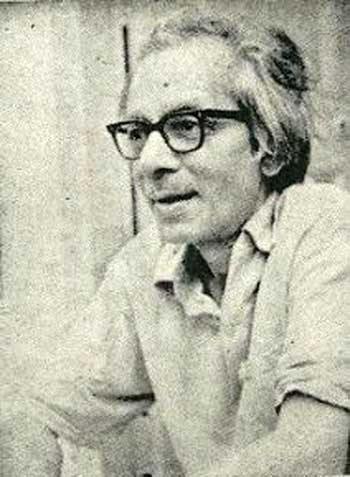
The question of livelihood does not arise while discussing the term ‘intellectual’. The Bangla term ‘Buddhijibi’—one who lives off one’s own intellect—is therefore not an accurate translation. Perhaps the remnant of our old Brahminical baggage[1] has lingered on in this rendering. Brahmins were the custodians of intellectual culture and they used to earn their livelihoods by cashing in on their intellect. After a long time, when another class emerged as the custodian of culture at the behest of British colonialism, they used education solely as means to secure livelihoods. Whenever the British anchored their boats near any village canal, many young men would earnestly request them to establish English-medium schools. There is a rather intimate relationship between intellect and livelihood[2] in what is commonly called ‘comprador culture’.[3]
It is rumoured that conflicts often arise in the mind-worlds of intellectuals, though only among those who are somewhat conscientious. Bertrand Russell was financially well-placed: the connection between his livelihood and the evolution of his thoughtscapes was not very close. However, such independent-minded people are rare in our country. The primary feature of the conflict that plagues the mind-worlds of intellectuals here is the contradiction with work or action. In other words, the occupation one is engaged in or the work that one does, is often at odds with one’s ideals and values. This results in guilty conscience. Many manage to eventually adapt to this condition through self-justifications and compromises. A few who are unable to do that find themselves in the unenviable position of being neither insiders nor outsiders.
Those who are able to adapt have kept a firm grasp over the market for a long time in our country. Politics is a huge question, especially since the so-called independence. The question of political bias in this age of schisms is what is behind the currency of the intellectual and the many issues they frequently raise. Over the last twenty years, the nation has undergone several crises, caused by both domestic and external factors. Various kinds of people were able to live comfortably behind rather convenient and apparently reasonable façades during the time of Sri Jawaharlal Nehru. The condition of the intellectual was decent. The bigwigs of political parties did not have to live in poverty. They gave up the thought and hope of an armed revolution and instead focused on parliamentary democracy and peaceful coexistence. I am not talking about the common people here—they are not intellectuals. A crisis once emerged over the conflict with China.[4] Our intellectuals are always too aware about world affairs. Kakdwip, Telangana etc.[5] do not touch them so much or feature as prominently in their writings. However, they became extremely proactive during the conflict with China. Almost everyone was singing to the same tune. Then came the war with Pakistan in 1965. Even if a section within the Left was faced with a dilemma in 1962, no such thing happened during the conflict with Pakistan over Kashmir. That, of course, could not be anything but a settled matter.
During the Bangladesh crisis, our national unity had assumed an unprecedented form. Intellectuals almost all compliant, excited; there was a flood of writings. Perhaps that was natural, for various reasons. The primary one was hatred towards Pakistan, which was expressed in a range of different styles and logics. Besides, many refugees had been residing in India for some time. The cruel torture carried out by Pakistani soldiers, hundreds of thousands of homeless and splintered families—there were certainly enough reasons for agitation. However, at least intellectuals on the Left should have had a clearer idea about the motives and machinations of our own government. It is not unfair to expect objective analyses and perspectives from intellectuals during times of crises. But Mujib’s ever-ascending crescendo, tall-tales of those who had to flee, and patriotic songs,[6] all contributed to the concoction of a heady mix—one that intoxicates even the young and precludes intellectual maturity. Save for one or two odd groups, no political party could afford to sing out of tune. Even those who were vocally critical of the government’s domestic policies, agreed with their allies and enemies alike that the foreign policy of the same government was pure, without any blemish. The opiate of patriotism is a wonderful thing. Although, some Mujib fanatics and pro-Mujib magazines have now become a bit skeptical. They have begun to slowly realize that the class-forces working behind the voice that shouts ‘Did I not tell you?’ on that side of the border and the voice that shrieks ‘Have I not done enough?’ on this side, are not only not socialist but are also opposed to the strengthening of democratic structure in both the countries.[7]It would have been better if they had thought of this before the thief succeeded in emptying their pockets.[8]
It becomes clear during times like that of the Bangladesh crisis or the conflict with China that the support for the economic, social, and political status quo has only increased. A reason for that is of course livelihood. It is not merely a question of survival anymore, nowadays, there is a growing appreciation of convenience and comfort among many. Another cause for such support is the insecurity generated by the growing possibility of a reaction even within this present system. The police and the armed forces are victorious today, but their morale is phony to a great extent. Their value-systems have been stirred; there is no doubt that such a stir has been brought about in a rather unwise manner, yet when so many people have sacrificed and will continue to sacrifice their lives for bringing about fundamental transformation of the system, it is no surprise that many others have clung to the old order even harder. This is precisely why there is so much lamentation regarding the death of the Sain brothers while most intellectuals have chosen to become mute as Lord Buddha over the deaths of so many other people—within and outside prisons.[9] They have taken refuge in morality and in the Congress.
There is probably no need for any serious discussion on the role of intellectuals under the present circumstances. Perhaps those whom we do not consider intellectuals will change the world as we know it before their intellect can be commercialized. Moreover, those who toil for a living are hardly considered intellectuals per se. At least you do not need to demonstrate customary deference to write about them.[10]
Translated from Samar Sen’s original Bangla essay ‘Chandrabindu Baade’ (1972). All annotations are by the translator.
[1] Samar Sen uses the tatsama (derived from Sanskrit) word ‘Aitihya’ (pronounced in Bangla as ‘Oitijhyo’) here, which if literally translated, means ‘heritage’ or ‘legacy’—not in tune with the sense one gets from the tenor of Sen’s prose here.
[2] Sen’s usage of the term ‘jibika’ here signifies something much more far-reaching: inclusive of commerce and transaction.
[3] Sen is alluding to the concept of ‘comprador bourgeoisie’ here, which in conventional Marxist discourse was posited against the ‘national bourgeoisie’. A comprador is an agent of foreign/metropolitan capital, who is in a subordinate but mutually advantageous relationship with the latter. As a class, ‘comprador bourgeoisie’ comprised indigenous collaborators—landed and urban, mercantile and professional—who greased the way for the exploitative intrusion of colonialism in local economy and society, resulting in the emergence of a hierarchical and hybrid culture.
[4] Sino-Indian War of 1962.
[5] Pre-eminent sites of communist-led peasant insurgencies in late and post-colonial India.
[6] Samar Sen singles out the genre of ‘Rabindrasangeet’ (songs composed by Rabindranath Tagore) in general and the song ‘Aamar Shonar Bangla’ (which became the national anthem of independent Bangladesh) in particular.
[7] Sen is taking jibes at both Sheikh Mujibur Rahman and Indira Gandhi here—both powerful orators wielding personal mass-appeal, whose rhetorical devices and antics often bordered on demagoguery. Both appropriated the rhetoric of socialism for their own political projects without bringing about any substantial change in the class nature of the states—of Bangladesh and India—which they respectively governed. Both were diplomatically supported by the then official custodian of international socialism: the Soviet Union.
[8] This is Sen’s take on a popular Bangla idiomatic expression: ‘Chor palale buddhi baare’ which literally means ‘everyone becomes clever once the thief escapes’—a dig at the futility of ex-post-facto wisdom. Sen’s phrase, however, reads: ‘Chor jnakie boshar age’, indicating a fundamental difference in the nature of the ‘thief’/rogue under discussion here—this one doesn’t flee but gets entrenched (in power).
[9] Samar Sen is referring to the controversial incident that took place on March 17, 1970, in Bardhaman, West Bengal, when a deadly political turf war between the Indian National Congress and the Communist Party of India (Marxist) was concluded with the murder of three brothers—all belonging to the Congress-supporting Sain family and who themselves were fugitives charged with several criminal cases—in the hands of a CPI(M) cadres-led mob. The deaths of the Sain brothers received disproportionate press coverage at that time and a systematic disinformation campaign was carried out by the then Congress leadership to obfuscate the facts of the matter. Many contemporary commentators, in their zeal to reduce this incident of complicated political violence to one of wanton vendetta, overlooked the Sain brothers’ own complicity as powerful henchmen of the Congress in many cases of murder, eviction and harassment—as part of an elaborate political turf war between the two parties and also a rapidly unfolding class-war between landlords and wealthy farmers on the one hand and landless tenants and sharecroppers on the other hand, in the district of Bardhaman.
[10] By dint of a peculiar Bangla grammatical convention, it is normative to add the deferential ‘chandrabindu’ (literally, ‘the dot over the crescent moon’) to third person (singular and plural) pronouns—resulting in a slight nasal tone when enunciated, when referring to someone old and/or revered. Sen, in his inimitable style, cheekily comments here that one does not need to add the ‘chandrabindu’ when referring to a common citizen in the third person—contrary to what needs to be done when writing about the esteemed and highly regarded intellectuals—in spite of the fact that they, perhaps, have a more important role in changing the course of history. This play of words lends itself to the Bangla title of this essay: ‘Chandrabindu Baade’ (literally, ‘Without the Chandrabindu’), which I have translated as ‘Sans Reverence’. One might perhaps discern the influence of Gramscian thought (especially the concept of ‘organic intellectuals’) over Sen here.
 Lokayata