
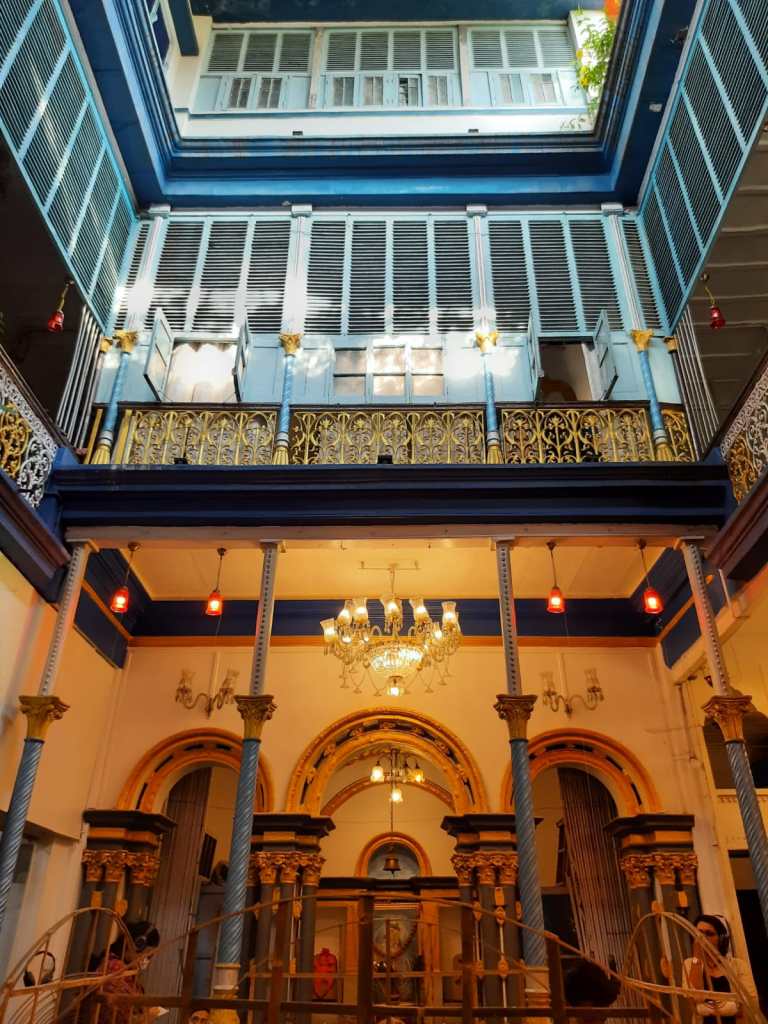
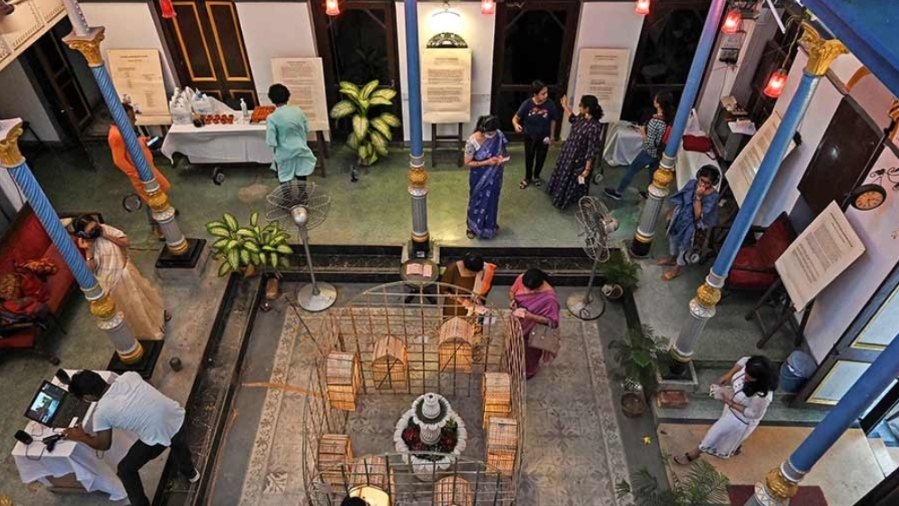
On 30th July this year, my friend Suchintan and I made an impromptu plan to visit an exhibition which claimed to showcase the “Sensory Heritage of Kolkata Streets”, having chanced upon its poster among many others pasted along the archaic staircase of the Indian Coffee House in College Street. Kamala Palace—an old aristocratic mansion of some bonedi (former Bengali feudatory) Mullick family in a narrow Shyambazar lane became our destination for the day. The exhibition was quite unique. Sixteen headphones, each equipped to transmit three characteristically Kolkata sounds, were left hanging around the courtyard for people to listen to. In the centre of the courtyard stood a decorated panel featuring eight to ten diffusers emitting scents typically associated with the city. The accompanying signboards described some of the sounds and smells, mentioning their importance in the quotidian lifeworlds of Kolkata.
The myriad sounds included the cries of hawkers, shoe shiners, women selling household wares, boatmen rowing on the Ganges, pickle and chutney peddlers, sellers of Ayurvedic medicines, rickshaw pullers, bus conductors; sounds of iron-welding, bazaars with people haggling, pre-recorded announcements of vans selling trinkets and utensils, birds chirping, dogs barking, etc. were also among the exhibits. The smells of several types of atars (aromatic distillates), incenses, assorted spices and even fish from the market filled our nostrils. Readers familiar with Kolkata would understand that some of these ‘artefacts’ characterized the everyday realities of the colonial city in the nineteenth and the twentieth centuries and continue to do so even today. Sadly, most of these sounds and smells are slowly disappearing from the city’s life. The organizers from UCL and Durham University termed this exhibition as an attempt to preserve these pieces of Kolkata’s ‘sensory heritage’ for posterity. They wished to inaugurate a discourse around the idea of heritage beyond the visual and the tactile, also venturing into making this a participatory exercise for people who are passionate about the city’s past and present. Currently, an effort is being made to create an ‘archive’ of these sounds on the streaming platform SoundCloud, which also enables any viewer to record and upload sound clips of their choice, which they feel to be representative of the Kolkata streets.
Both of us were quite impressed with the thoughtfulness of this event. The attempt to challenge the mainstream discourse on heritage, mostly dominated by statist teleologies, deserves praise. The democratic and participatory role that common people can potentially have in the creation and preservation of such heritage has also been acknowledged in the effort. However, my (often unnecessarily) critical mind had questions to ask. I am very critical of what the late Marxist theorist Aijaz Ahmad termed as the ‘Cultural Turn’ in the academy—a phenomenon which heralded the complete relegation of social, political, and economic concerns to a subsidiary position, while cultural considerations became primary. The attempt to problematize the mainstream conception of heritage is often reduced to an expedition into the darker, remote alleys of culture, and this exhibition—with its antiquarian aesthetic and nostalgic predilections—did the same too. However, in the town of history, if the alleys of culture do not intersect with the streets of political economy, the town becomes nothing but an agglomeration of dead ends. Any discussion on cultural preservation shoots off from the very premise that some relics of the past are gradually departing from our material and spiritual worlds in ways they perhaps should not. The organizers of the exhibition clearly demonstrated how these ‘artefacts’ are gradually disappearing from the city but did not try to really probe why it was happening in the first place.

The usual culprit seems to be capitalist modernization, and its symbols of ‘progress’—machines, automobiles, flyovers, skyscrapers shopping malls, etc. Any postcolonial theorist will blame modernity for the ‘cultural loss’ and start theorizing about breaks and continuities in cultural patterns of the society under consideration. However, these concerns should not be reduced to the politics of culture alone. Rather, such concerns are underpinned by serious political and economic questions which need proper attention. The story of cultural loss of olden sights, sounds, and smells is also a story of political and economic displacement and dispossession of people involved in such occupations. The aestheticized presentation of the ‘artefacts of sensory heritage’ somewhat makes us forget that behind the sound of every street vendor’s cry is a working person of flesh and bones, living with their daily struggles and socio-economic exploitation under a semi-feudal and semi-capitalist order. Such poor workers, who have been involved in traditional occupations for years, are rendered unemployable due to changes in the socio-economic structures and are then compelled to work for less in more informalized sectors.
According to Karl Marx, technological advancement under capitalism presents us with a dialectical relationship between easing of labour, and large-scale displacement of the working class. The modern city bears the massive weight of displacement and dispossession of the working people. An example that immediately comes to my mind is that of ‘Ultadanga’ (twisted water bank) in Kolkata, which gets its name from the past existence of fisherfolk around living around the now non-existent saline marshes in that area. These fisherfolk were ultimately dispossessed due to the increasing pace of urbanization. The advent of mass production sounded the death knell for a lot of the traditional occupations. For instance, even a few years back, many streets of North Kolkata used to echo the melodious shrieks of men crying out ‘Sheel kataao’—sheel being the solid stone slab against which the pestle was rubbed to grind spices into paste, which had to be chiselled from time to time. However, with the introduction of mass-produced and packaged ground spices in every retail shop, sheel-cutters now find themselves out of work.
Except for a few areas, traditional vendors and peddlers are rarely seen in the streets of Kolkata today. The voices of bus conductors can still be heard, but with the systematic defunding of the public transport system in West Bengal, the number of buses running on Kolkata streets has been significantly reduced, especially in the wake of the post-pandemic slump. The infiltration of e-commerce in the informal and services sector has gravely affected the traditional bazaars, endangering their existence as well as that of the sounds and smells associated with them. Poor hawkers no longer find a space along the hi-tech broadways and well-planned streets. It is not just human sounds that are at the risk of disappearing. The chirping of even common birds around our neighbourhoods are slowly vanishing due to the systematic deforestation in the city to make way for multi-storeyed concrete buildings and the installation of hideous cellular network towers.
A lot of these changes happened as part of the neoliberal project embraced by the central and the state governments from the early 1990s. Promising holistic prosperity, the USA-led Washington Consensus forced many developing countries into accepting Structural Adjustment Programmes (SAPs), leading to the displacement of millions of working people from their livelihoods—by opening up domestic markets to big capital, depleting indigenous resources for extractive purposes, and destroying social security nets through privatisation and decrease in state funding. With the squeezing of incomes and of basic amenities such as public healthcare, education, and civic facilities, the urban poor—who form the lifeline of the cities—have been forced to live in deplorable conditions and into undertaking more exploitative occupations. In Kolkata, the newly affluent Bengali middle classes, who could climb up the social ladder owing to these reforms, saw these changes as the necessary markers of urban progress. They either turned a blind eye to the consequent wide-scale displacement of the city’s working class or dismissed it as merely a collateral damage of industrial prosperity.
This tiny experience and my not-so-tiny ruminations led me to conclude that the depoliticization of the discourse on sensory heritage is a part of the larger ‘Cultural Turn’ in the academy. Any effort that seeks to divorce socio-economic factors from cultural considerations amounts to the development of a very skewed worldview. ‘Capitalist realism’, as Mark Fisher had put it, robs us of the ability to imagine a future radically different from ours. When culture is given primacy in analysis, the status quo remains unthreatened. A radical reconstruction of the current society calls for a transformation of its socio-economic base through organised mass struggles. All radical breakthroughs in the academy too, have been prompted by peoples’ movements. Any academic intervention claiming to be radical—and slated to have important political ramifications—would not serve its said purpose if it does not centre the discourse around working people and their movements. It would eventually get buried under debris in the blind alleys of Culture, never to have a life of its own.
 Lokayata
One thought on “Walking Through the Blind Alleys of Culture: A Glance into the Politics of ‘Sensory Heritage’—Ananyo Chakraborty”