
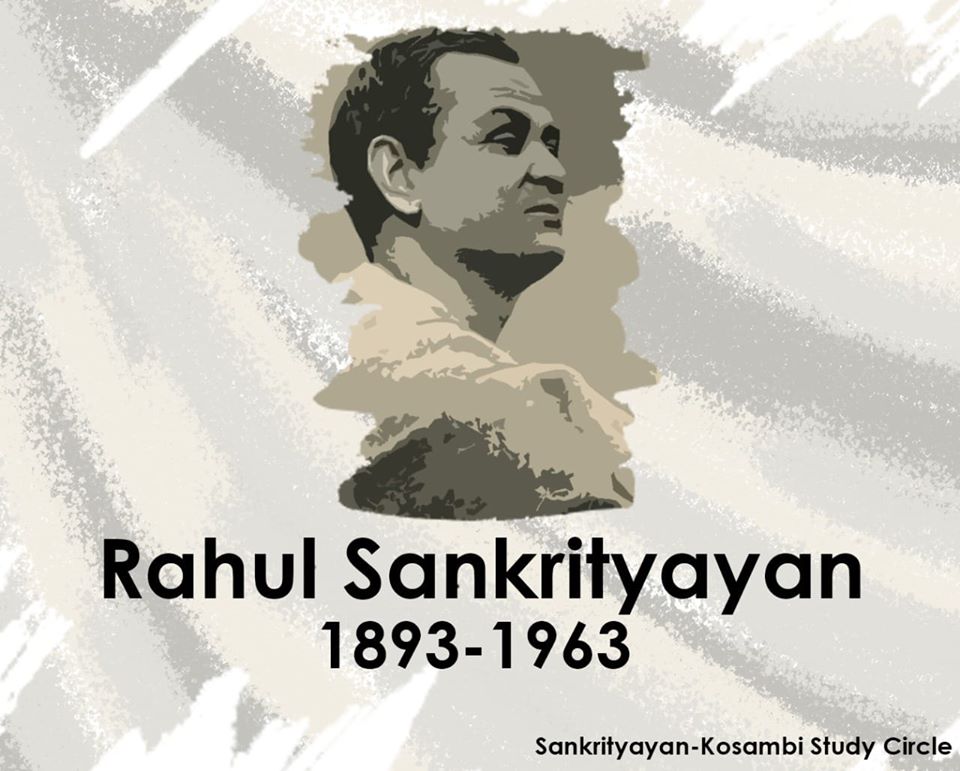
The greater the antiquity of any civilization, the stronger it is gripped by the bonds of mental slavery. Since the civilization of India is unquestionably ancient, there are greater impediments on its path of advancement. Mental slavery is the biggest hurdle to progress.
Our sufferings, our myriad economic, social and political problems are so intricate that we cannot come up with solutions until we think about them with a clear outlook and independent reasoning. Since the beginning of the current century, there was a deluge of nationalism in India, at least among the educated youth. Despite having some merit, this nationalism was in many ways short-sighted.
To reimagine our past as unblemished and glorious, that is, to attribute things of the greatest political importance in the twentieth century to our sages, writers and philosophers, monarchs and royal institutions was a part of this nationalism. Inspired by this misplaced zeal of proving the antiquity of our civilization as well as the ancient superiority of its inhabitants over other nations, we passed off gibberish under the garb of historical research. When this was rejected by western scholars, we were quick to decree all occidental intellectuals—English and French, German and Italian, American and Russian, Dutch and Czechoslovak—as unscrupulous and conspiring to spread falsehoods about our nation. We claimed that they did not allow our hallowed Vedas to be ascribed a date earlier than three-and-a-half or four thousand years ago (though they were formed exactly one billion ninety-two years ago). It is the opinion of these gentlemen that if we somehow prove our civilization, our books and our sages to be the oldest in the world, our work will be accomplished.
Maybe the world will take cognizance of the antiquity of our rights and grant us liberation without any furore. Otherwise, in any case, when our youth is inebriated with the pride of having the blood of the progenitors of our ancient civilization flowing in their veins, and when they are readily willing to make great sacrifices for the advancement of their nation, how long will it be before we attain independence? Today, we might not have firearms, cannons or machine guns, nor possess submarines and planes that inflict cataclysmic destruction, but if we prove the merit of King Bhoja’s wooden flying horses and the aphorisms of Shukracharya, then all our problems will be solved. Is there any greater idiocy than getting so exultant over the achievements of our forefathers that most of our energies are spent in eulogizing them?
Because of this obsession with our ancient history, we are chained to our nostalgia about the past, which provides the impetus to blindly accept the religious doctrines of our ancestors. While there is still a possibility of sifting truth from falsehood in secular matters, when it comes to religious dogmas, one suspends all rational thought. A rogue employs his skill, wealth, deception and promises of various temptations to entice a few self-serving and ignorant people and forms a cult, after which thousands of people flock to him like sheep for slaughter. Though he might have been a rogue all his life, after his demise, he is deified by his followers. If this group succeeds in their propaganda for a few centuries, he will be elevated to the position of one of the holiest souls in the world.
Even if we leave out the things of the past, I have myself witnessed people, some of whom have died while others are still alive, whose sickening inner lives were marked by selfishness and profligacy. Despite this, their devotees used to consider themselves blessed on seeing their apparent philosophical insight and harmonious temperament. On close scrutiny, we will discover that the monasteries and ashramas of these godmen are open schools for the propagation of hypocrisy; in fact, proselytization of religion is an extremely lucrative employment. A large number of people are engaged in it purely out of material concerns. There was a mahatma in Ayodhya. Lord Rama was so pleased with him that he came down from his celestial abode and took him as his wife. Yes, took him as his wife! Although he was a man, through the Almighty’s grace, he attained the form of His beloved. Truly, what in this world is impossible for Lord Rama! If a stone can be transfigured to become a human, then surely it is not a big feat to convert a man into a woman. Nowadays, these changes are seen spontaneously so many times.
For the past fifty or sixty years, a new outlook of justifying the scientific validity of all things irrational, including the existence of ghosts and magic has taken root among people. Naïve Indians believe that halfwits do not graduate from Oxford and Cambridge and that no Jack or Johnson ever says anything unscientific. These infantile pundits have started employing their half-baked knowledge to legitimize and explain the presence of ghosts, deities, sages and worshippers on the basis of scientific ‘principles’ that were propounded thirty years ago.
Even though 75 percent of these theories have been proved wrong, for blind devotees the texts prepared from the old science are infallible. The history of India is vast—both in terms of time as well as space. This vastness is equalled by the list of our inanities. Blind nationalism and its prophets have instilled in us an intense devotion to our past and to nourish this ignorance we have taken refuge in absurd and morally bankrupt scientific theories. Is it a surprise that people are mired in ignorance? A land where not just airplanes but wooden horses fly in the sky, where not only gunpowder and firearms but flames emanating from people’s mouths are potent enough to incinerate millions of enemies in an instant, where the subtle philosophical contemplation and deliberations of its people continue to astound the world—can such a place ever record anything false? Earlier, our nonsensical views were justified through attempts to summon ghosts on tripods and by means of mesmerism and hypnotism. Now, even acclaimed scientists are glorifying Harsuram and Hariram Brahma. When even the Nobel laureate Oliver is authoring books on ghosts and promoting them unabashedly, can we fault our own countrymen?
Until recently, educated people considered astrology to be a hoax, but now these very people are supporting it. They consider it to be an unerring science. In fact, our newspapers are trying to outdo each other in printing the predictions of astrologers. On 27th August, Searchlight printed the meteorological prediction of an astrologer on one of its first pages. Is there even a need for spending lakhs of rupees on scientific meteorological equipment in Poona?
It is the era of swadeshi; Congress has successfully formed a cabinet. What astrologers need to do is to take a large deputation to meet the Chief Ministers. These astrologers should be assured that in the six provinces that have Congress governments, there would hardly be any minister who does not have faith in astrology. I am convinced that they would readily reduce their fees for the larger welfare of the nation. What then is the use of maintaining meteorological instruments, seismographs for earthquakes, etc. and employing experts on large salaries? Astrologers can certainly do their job effectively. They do not even require machines or data from outside. Sitting at one place, an astrologer can predict everything; in fact, with such a system, a single one of them can make forecasts about rain, droughts and earthquakes. If the attainment of independence gets delayed, he will attribute it to the birth charts of the leaders. Just this year a king wanted to travel abroad to have a look at the emperor’s throne. Not only was he anxious about the evil planets, but preoccupied with worries about his mother. However, an astrologer, after carefully examining the position of Aries and Gemini, assured him that all the planets were in his favour. He even promised his mother that no harm would come to her son. Everyone was pleased and the astrologer earned five thousand rupees. Pray tell me—can life insurance get cheaper? In fact, there is another benefit in such a system. If, in every province, we have a government-appointed astrologer along with ten to fifteen assistants, ministers and officials will not have to roam around in lanes to consult them. The yearly horoscopes of their wives and children will be sent to them on time. We should definitely encourage indigenous businesses and what can be more Indian in heart, mind, soul and labour than astrology?
Are our dogmas limited to one or two, which could be summed up in a small article like this? In fact, stack after stack of files can be spent on its documentation. What is surprising is that our leaders want to march on to progress while being weighed down by the burden of these absurdities. They have unflinching faith that the god of Baikuntha, the nine celestial planets, astrologers and exorcists will all assist them in their endeavours.
Take our caste system for instance. It is another prominent invention of our great sages which we take pride in. With the nationalist awakening, a few people started criticizing the caste system, yet even today most of our leaders are willing to glorify this innovation of our ascetics. The leaders have realised that these caste rifts are one of the greatest sources of discrimination and division. A few years ago, these people had formed caste-based organizations and even now, many are disinclined to leave them. I am not talking about other leaders; my emphasis is on those in the Congress. These helpless people have become worn out trying to find a way to carry both nationalism and the caste system on their shoulders. Some of them must have realised that this is unfeasible. True nationalism can never appear unless you are ready to smash caste divisions. If you have not crushed the caste system your actual world lies within your caste fold. With outsiders, there is just a makeshift agreement. When you ascend to any position, your fellow caste-members would be the most influential in determining if you decide to retain your honesty. You will be compelled to take care of them by providing them with employment, sending them to sub-committees and providing them with recommendation letters. There are thousands of chambers in the heart of a man but one will never find casteism in one chamber and unalloyed nationalism in the next. Just like anyone who enters the peasants’ struggle should be aware that they have to embrace communism, a person who sets foot on the path of nationalism must realize that they have to tear down the walls of the caste system. If someone aspires to become a national leader, yet nurtures the desire to maintain intimacy with their caste kin, they will either turn fraudulent or meet with failure. How can one maintain affinity with their caste members while not simultaneously betraying the people of other castes? Ministers should exercise special caution since comradeship with their caste brothers can easily discredit them. In my opinion, it is beneficial for the region, the country at large, the Congress party as well as for the leaders on an individual level if they arrange marriages for at least one of their sons or daughters, nephews or nieces, or grandchildren across caste lines, just like Mahatma Gandhi and Rajagopalachari had done.
We should not simply bide our time blindly. It is necessary that we are ready to pitilessly shatter and throw away every chain of our mental bondage. This inner revolution is certainly needed more than external manifestations of rebellion. With a sword in our hand, we will have to move on by striking down orthodoxies everywhere—left or right, backwards or forwards. Revolution is like a tempestuous fire. It will not simply burn a hut in a village and leave everything else unscathed. All the houses—pucca or otherwise, will be reduced to ashes in its mighty conflagration and we will have to lay the foundations for building a palace anew.
First Published as ‘Dimagi Gulami‘ in an eponymous collection of essays in 1944. Translated from the original Hindi text.
 Lokayata
2 thoughts on “Rahul Sankrityayan’s ‘Mental Slavery’—Translated By Satyam Jha”