
“Painting is not made to decorate apartments; it is an offensive and defensive instrument of war against the enemy.”
—Pablo Picasso
Art plays a pivotal role in shaping the nature of protests during any social upheaval. It allows the people to give a new direction to their political imagination and make powerful statements challenging authorities. Visual representation often helps people to connect to shared struggles against injustice in a more vivid and intimate manner. Thus, the language of art functions both at the personal and the universal level. It resonates with the individual, who is facing hardship in their daily life, and it resonates with the larger social group which is affected. By empowering people and forging together a collective consciousness, the reach and message of a particular social movement becomes more concrete and consolidated through protest art. In this article, I will be analysing some of the important ways in which paintings have played a role in some 20th and 21st-century social movements. I will try to delve into the common themes prevalent in diverse cultures and ideologies which have used art as a medium of protest as well as commenting on the future of such art in virtual spaces. The latter part of this essay will focus on the massive impact of social media and the internet on protest art and protest movements as a whole, consequent problems and possible resolutions.
Guernica, by Picasso

Guernica is one of the most powerful paintings by Picasso, depicting the moment the town of Guernica was bombed at the request of the Spanish Nationalists led by Franco. The recurrent themes are that of destruction and death, and the sombre grey and black colours are used to bring out the disturbing theme. The bull and the horse are recurrent motifs. At the time of the bombing, most of the men in the town were away serving as soldiers in the war, and a large number of those killed were women and children. Through this painting, Picasso depicted the cruelties of the much-hated Franco regime and challenged it. He was a staunch believer in the inherent power of people to liberate themselves from the clutches of war and political destitution.
Yoko Ono, Cut Piece
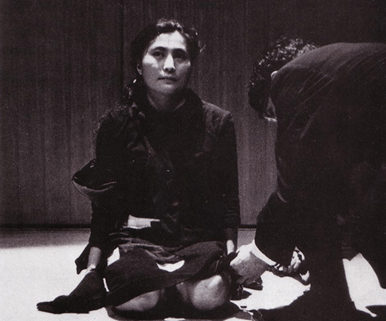
Yoko Ono did a social experiment titled Cut Piece in the year 1965. She would sit on stage, wearing a dress, and hand over a pair of scissors to the audience. The people would be encouraged to come forward and cut a piece of clothing. At the very beginning, people were reluctant to come forward and participate, but slowly, the participants started becoming more sexually aggressive. There were taunts and a lot of jeering, with one man reportedly remarking, “You should do a cover for Playboy! “The final male participant cut off her bra strap and she was left almost naked. This is one of the most powerful public performances that highlights how quickly a woman can be turned into a sexual object. She was an important icon during the feminist movement of the 1970s, which dealt with the important questions of identity, patriarchy, and the controversial issues of domestic violence, sexual harassment, and marital rape. A large number of critics have mentioned that she was commenting on the victimization and the subordination of women in society.
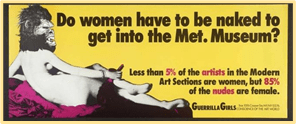
Graffiti
Graffiti art offers a fascinating study of everyday resistance. It allows the common people to express their dissatisfaction with government policies and authoritarian rules. It has been described as a sort of modern-day guerrilla warfare, and in the words of Bansky “If you do not own a train company, go and paint on one instead.”
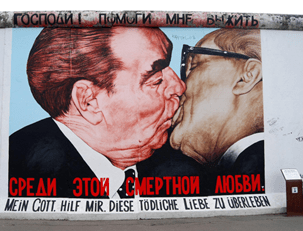
The Berlin Wall has many beautiful murals and paintings but this one stands out from the rest. It ironically captures the moment Leonid Brezhnev and Erich Honecker had signed an important arm deal through which Germany would continue providing support to the Soviet Union. Vrubel remarked in an interview with Andrey Borzenko on 11 November 2014 “But I wanted to paint specifically on the Berlin Wall and specifically Brezhnev and Honecker’s kiss. In this painting, there’s one German and one Russian, and the Berlin Wall is about the same thing but in reverse: here [in the painting], there’s total love, while the Berlin Wall separates two worlds — it was a perfect fit”.

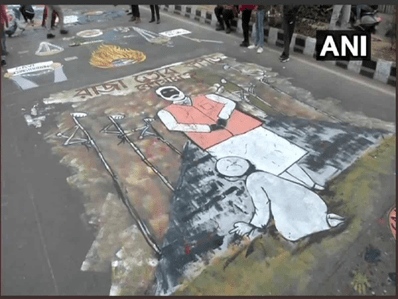
These two pieces of graffiti are a reminder of the protests that took place in 2019 across the country. The CAA and NRC laws had roused thousands of people to take to the streets and protest against the ruling government. The words “Raja tor Kapor Kothaye?” loosely translates to O King, where are your clothes? It is a line that has been taken from a famous poem by the Bengali poet Nirendranath Chakraborty, titled ‘Ulongo Raja’ (Naked Ruler). These artworks expose the hypocrisy of those who are in power.
The Sahmat Collective Posters
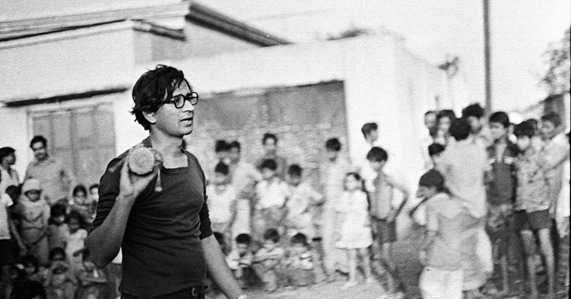
Safdar Hashmi was a gifted playwright who revolutionized street theatre in India. He was associated with the Communist Party of India (Marxist) as a lifelong member and is credited with the formation of JANAM (Jana Natya Manch). He dealt with issues ranging from farmers and women’s rights to the systematic corruption that pervaded politics and society during those times. He spoke about unemployment, and the distress of the working class, and tried to voice their concerns by being their mouthpiece. He was killed while performing his play Halla Bol in 1989 when goons from the then ruling party attacked his troupe. Within some days, hundreds of artists, writers, poets, and painters came together to create Sahmat, which had the motto of preserving the freedom of cultural and creative expression. Every year, Sahmat sends a poster to street theatre groups from around the country, who make use of it on National Street Theatre Day. The Sahmat posters help us to visualize the political changes and turmoil through which India has progressed over the years.
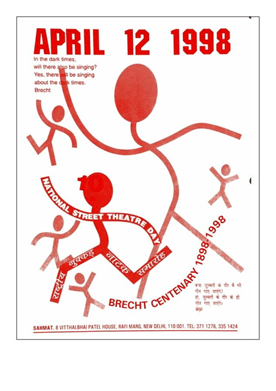
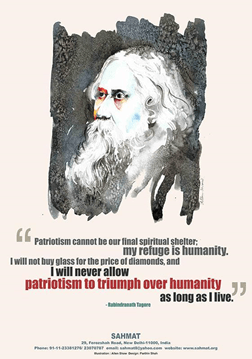
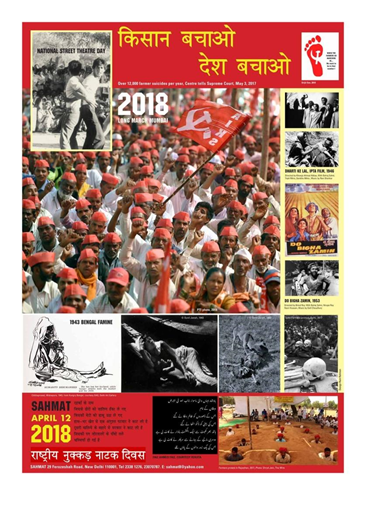
Many great artists have been featured and have worked on these posters. MF Hussain had designed the poster which was published in the year 2010, the theme of which was loneliness and love. The poster released in the year 1998 had a tribute to the German poet Bertolt Brecht, featuring his lines:
In the dark times, will there also be singing?
Yes, there will be singing about the dark times.
The Common Man, RK Laxman
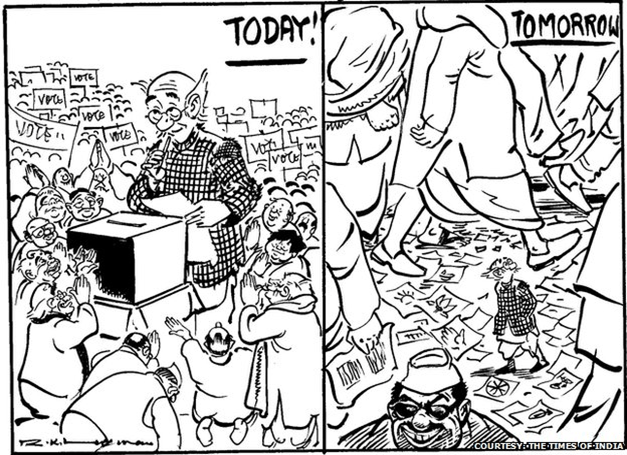
RK Laxman’s satirical drawings, featuring scenes from everyday life, bring out the irony omnipresent in India’s democracy. The Common Man sits apart from the rest of the people, cutting sharply across all divisions to paint the real state of affairs in the country. The cartoons freeze a particular moment in time and usually feature a single line of text. As Sushmita Chatterjee notes, “His cartoons emphasize that the art of ideal caricature is to bring out the essence of personality through credible exaggeration.” For more than 50 years, the Common Man has featured in the Times of India, capturing the political pandemonium that never stops.

Mithila Painting
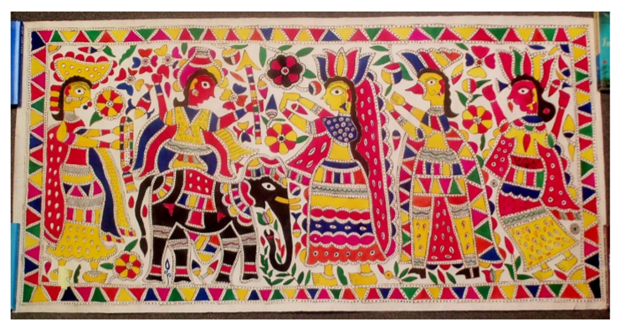
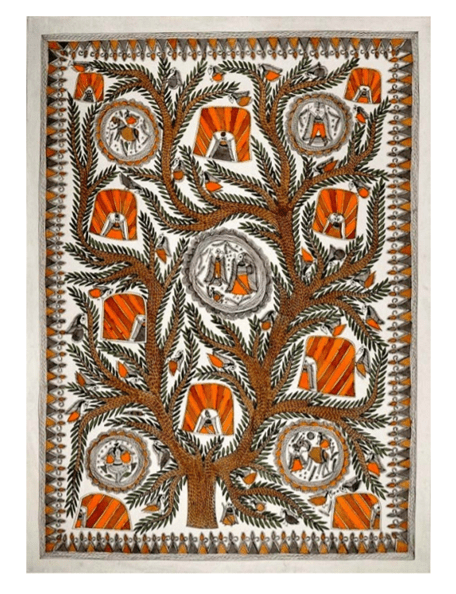
Madhubani art has evolved in different ways among the different castes present in Bihar. The Karna Kayasthas have evolved the Kachni style; the Bharni sub-genre has been developed by the Mahapatra Brahmins who are predominantly scribes. However, I want to focus on the works of tribal women and the lower castes who have overcome large barriers to earn recognition around the world. The Gobar style was developed by Jamuna Devi, which involves using a subtle brown cow dung wash to prepare the paper of the painting. These paintings have been exhibited in New Delhi, Japan, and other places around the world. The recurrent themes include episodes from an oral epic that features the mythical hero Raja Salhesh and his powerful adversaries. According to Narayan Sinha, by focusing on themes that are not drawn from the Ramayana and Ram (mostly present in upper-caste painter’s works) the Dusadh people want to quietly confront the worldview of the upper castes and develop their ideas independently.
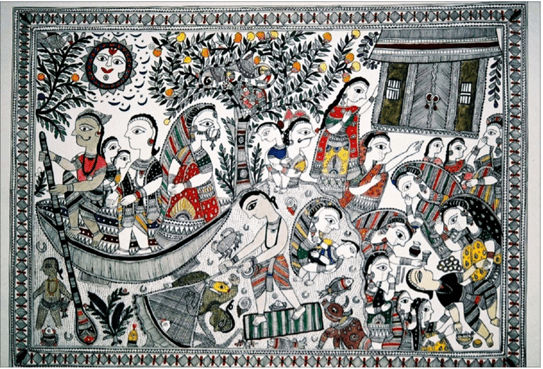
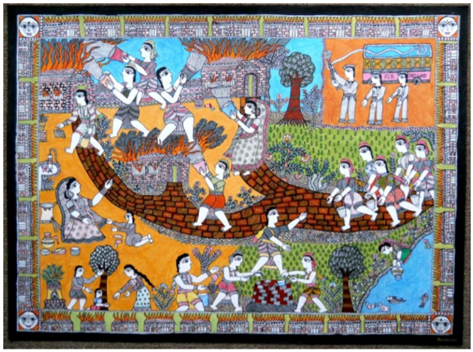
Another important subaltern form of art is the Godna style, which is a kind of tattoo painting. Dalit women from the state of Bihar look upon this style as a path for their emancipation and a restoration of the dignity of the self. The most famous painter of this tradition was Chano Devi, from the Chamar caste. She was the first to experiment with natural colours and different folk themes that reflected the life of the lower castes of the society.
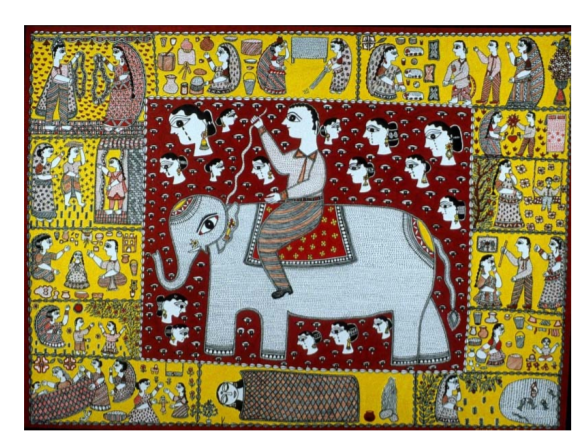
Patriarchy is deeply rooted in Mithila. The men take the most important decisions and restrict the imagination of women. However, a critical attitude has emerged in society, and it is reflected in some of the paintings. A great example is Sugata Kumari’s Beast of Burden. The principal image is that of a man riding an elephant. All around him has been drawn the life-cycle of the Mithila woman and the struggles that she has to face.
The Future: Protesting Through Art in Virtual Spaces
As we can see from the wide-ranging examples drawn from different societies from around the world, art helps to bridge the gaps between people and educate the society about structured inequalities. As we live in a globalized and technological world, the spread of information and art through social media platforms has taken the world by storm. Digital platforms are used to create posters and banners and people in the remotest corners of the world can see them on multiple devices and make them go “viral”. What remains constant is the desire to share stories of injustice and struggle, to break the narrow domestic walls, to empower generations and guide them towards a more egalitarian world through art.
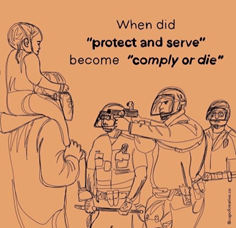
One of the most effective means of critique employed in today’s times is memes. There has been a constant rise in the popularity of memes as a means of satire to openly challenge oppressive government policies. Memes feature regularly in major protests worldwide and their themes are eclectic and universal. This rapid changing of the social landscape has also allowed Twitter to be an important platform where ideas are constantly exchanged as well as a space where duels are fought constantly between world leaders, different organizations and any person with access to an internet connection and a smartphone. The goal seems to be clear; to come up with witty comebacks and arguments framed within 280 characters. Twitter trends and Instagram hashtags are also used as instruments in the new protest movements that are taking place.
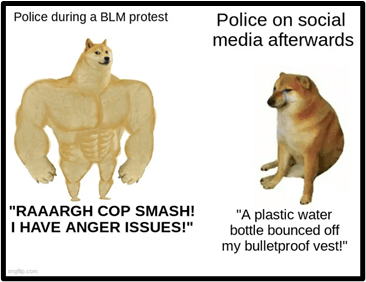
It is important to point out some consequences that can crop up in the near future. Firstly, there seems to be little accountability on either side of the discourse. One just has to follow the tweets of Donald Trump to understand that. The lack of accountability and the relative anonymity one can maintain (for reference, the vigilantism of the online hacker group Anonymous) even while posting memes can often backfire instead of furthering the message of a protest movement.
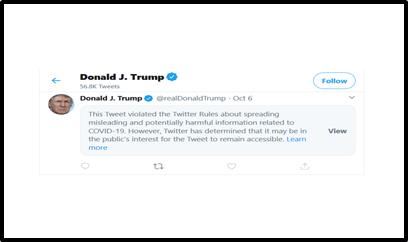
Image: Twitter deleting an offensive Donald Trump tweet. Eventually, his account was suspended.
The second important point is larger in scope and needs serious discussion and resolution. In a democratic state, governed by laws and where people subscribe to a constitution, it is possible to hold the government accountable in a court of law for repression of freedom of speech. There are inbuilt mechanisms within most constitutions for the safeguard of such rights, even though in practice we have often seen them being simply ignored. However, when we think about Instagram, Twitter or Facebook, we are going out of the domain of the state. This is one of the important points of difference in the case of protest art in social media. Censoring and deleting content that does not comply with the wishes of either the state or these corporations can be done much more quickly and easily. We do agree to some conditions when make an account, but it is extremely easy for these authorities to ban our account, simply because what constitutes freedom of speech on these social media platforms is not clearly defined and laws regulating it do not exist. Resolving this issue will go a long way towards safeguarding protest art in virtual spaces and allowing people to use their creative liberties.
 Lokayata
One thought on “Documenting Dissent Through Art—Rayan Chakrabarti”