

Something funny happened a few days back. I watched an online streaming of Frankenstein by the National Theatre (thanks to the current circumstances) with some excitement and it was quite an experience. I had never seen something that magnificent on a stage before—with rolling steam engines and all grand elements on display, I was hooked on its optics and spectacle. I was talking about this to a friend and without a moment of hesitation, he asked me, “Do you identify yourself as a fascist?” It was nothing short of Frankenstein’s horror for my liberal fetishism. Even though I had burst out at him instantly, the thought persisted in my mind. For the sake of resolving this cognitive dissonance of mine (at least worth a try), I will be taking the reader and thus myself on a stroll through the history and life of spectacles.
You can look up Aristotle, Debord, Orwell all you like, the basis of spectacle is the same. It is an astounding ceremony (of celebration or grief); an image, that not only persuades but hypnotises you by appealing to your senses. The spectator becomes a part of it and by extension, a part of what it represents, ideologically and stylistically. It is grand and subtle at the same time. Its grandiosity is what attracts, its subtlety makes you forget self-doubt if you are attracted irrationally. Spectacles carry an irrefutable message, in sync with the ideology of those involved in creating and sustaining it, and directed to its willing/unwilling participants (Marxist scholars argue it’s the latter). Debord remarks, “The Spectacle presents itself as something enormously positive, indisputable and inaccessible. It says nothing more than ‘that which appears is good, that which is good appears’.’’
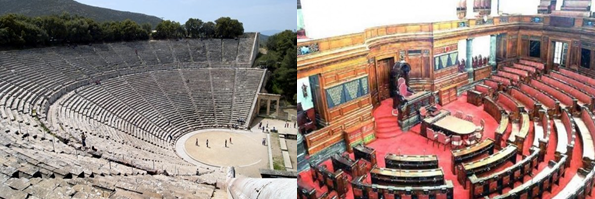
Let us take a look at the ancients—the Greek theatre. The ‘spectacular’ of the theatre as told by Aristotle is what attracted the audience, what made them sit through it. Greek theatre was performed in the midst of celebration, just after the new harvest, and carried in it the Dionysian atmosphere of merry-making, enjoyment and wildness. However, when one looks with a greater detail at the plays staged, one finds an essential Apollonian character representing the order of Divinity and Destiny. Thus, even when there is a Dionysian setting, the State mediates in making its presence and order felt through the metaphor of Apollo, not by something quite apparent as the army but through the tragic drama. This is what Debord would say is the ‘diffused’ or subtle spectacle.
The more apparent or ‘concentrated’ spectacle used to present itself just before the theatre would start. Military generals would offer libations to the gods, and orphans whose parents had died fighting for Athens and were now cared for by the state, would be paraded. The state thus created the spectacle of the theatre in Greece which the civil society helped sustain and permeate. It was central to the idea of ‘Greek Democracy’, which at once perpetuated the power of the state and exposed the oppression of its subjects (remember that only male citizens could attend these theatres, women and slaves were excluded). Roman society, likewise, engaged in the magnificent spectacle of the chariot races and Gladiator combats that not only showed the might of the Roman Empire but also displayed the subservience of its subjects to the empire and its emperor.
Creating spectacles carries in itself an intense play on rhetoric. Aristotle characterised rhetoric as a medium of persuasion. For him, with ethos and logos, the dominant and most important ingredient was pathos or that which served to appeal to the emotions of the audience. Every kind of spectacle that emerges, plays on this pathos and by extension to a degree of romanticism. The Romans romanticised might and valour, the Rajputs honour, and the French romanticised romance itself. Forget history if you want to at the moment, and take a look around you. You’ll hardly escape seeing politicians romanticising purity (which of course comprises casteist, racial, cultural and national purity). The ‘spectacular’ also has a degree of social amnesia attached to it. Collective memory is reshaped and moulded and parts are conveniently forgotten to suit the present in creating a whole spectacle. I gather that naming and renaming cities and building statues are the more subtle spectacles that build on this social amnesia. If a state of distance is required to participate in a spectacle, a certain kind of amnesia is required to deal with the uncertainty and the burden of the present.
Coming to another question, how does romanticism get precedence in the creation of spectacles, and if romanticising ideas is so inherently linked with creating spectacles, are there different kinds of romanticism? The French Revolution witnessed the parallel rise of Romantic poets like Blake and Wordsworth. They argued for emphasising on folklores and a romanticism that had lent itself to nationalism then, and continued to do so at a later period. Here I think it’s futile to talk of romanticism or rhetoric in a modernist view of positive/negative distinction. It is also important to take note of a modern perception of ‘good’ and ‘bad’, when we think that distinctions in romanticism are to do with difference in ideologies as well. Romanticism in some way or another is present in all aspects of life independent of the spectacle. So, how do we come to differentiate romanticism when it is used in a spectacle? A friend of mine ascertains that it has to do with degree.
Romanticism, when used as a response highlighting the importance of looking at senses and emotions is of a lesser magnitude, than when romanticism is used as a blank slate to formulate and impose certain wills and whims of a cult leader or a figure or even a group. I think the performance that triggered this discussion comes handy in understanding this. Frankenstein is a Romantic period text. The character of Frankenstein’s Creature himself lends itself to a kind of romanticism that is closely linked with humanism. He is talking about being in touch with one’s senses and emotions, empathy and kindness, and dreaming of equal dignity and love. Quite ironically it is Frankenstein or the creator, who succumbs to his romanticism of science and rationality and in exercising his will to play God and mould a world where his truth and passion should reign.
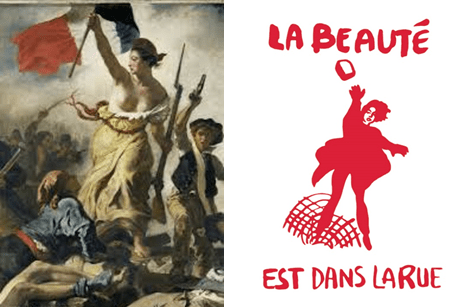
The modern-day spectacle unfolds itself not in any apparent and easy to spot way as they did under the Nazi or Fascist regimes, wherein the cult of leader and force established solid and very explicit spectacles of parade, uniforms, ceremonies, and the police. It is much more difficult to spot the spectacles around us now and decode how we are constantly feeding on these and rendering ourselves into non-thinking beings. Guy Debord of the Situationist International argued that in the modern capitalist society, we are constantly fed with images and spectacles of a certain aspiration of capitalist life, and the audience, instead of ‘living’, find themselves having to live upto a representation of these images by buying and consuming, and therefore sustaining the spectacle. The situationists urged (yes of course they used rhetoric) to break free from the mundanity and banality of such spectacles and to actually live and experience life in situations and moments. Take a look at the slogans so imbued in a rhetorical play in the May ’68 Paris student revolutions: “Ban all applause, the spectacle is everywhere”.
It’s quite hard to not talk about contemporary politics when we think of the ‘spectacular’ and theatrical. An image or for that matter a romanticised idea is constantly used not only to appeal for mass mobilisation but also to justify state power and control. Not only are prudence, knowledge, and rationality supposed to take a back seat but the inferior worth of these vis-à-vis the romantic ideals of myth, strength, and might has to be established. The Modi regime in India is constantly playing on this idea. We are feeding on spectacles of the country’s apparent might and power. A euphoric utensil banging, Modi’s yoga rituals, mob-lynching, the Bhushan contempt case are all, though varied, examples of creating and feeding spectacles to the audience that strengthen the power of the state at their cost.
All of this is still to say that it is wise to talk of spectacles without putting a value judgment on it. Spectacles are somethings that simply exist, and even though they hold considerable power over people, they exist in every kind of social participation and are not just created by those placed in a considerable hold over power. One cannot help talking of spectacles inherent in the very movements to challenge those in power, but also more importantly, those that are found in art. Spectacles are an intelligent use of rhetoric, which also create in us an epiphany—an intensity and gush of emotions. While spectacles in some sense make society and politics banal, politics and society without spectacles become banal as well.
I have reached the tedious end of this discussion that rose from Frankenstein’s horror, no…from Frankensteinian horror (I stand corrected). My friend, then, when he referred to my fascist tendencies, albeit in a playfully loose sense, was talking about something much deeper. My attraction to sheer visuals and propensity to sense-entrapment, historically carried with them a fascist tendency. By engaging intensely with the spectacular, one was showing a degree of manufacturing and succumbing to what Umberto Eco has called ‘Ur-Fascism’ (Eternal Fascism). However, I think I have talked and deliberated on this enough to leave me in a state of unconvinced bewilderment. I do not think resolving my dissonance was ever the aim of this essay. Rhetoric permeates everything; even the way in which I have written whatever the handful of readers left are still trying to read, I have quite consciously used rhetoric to convince my confused self and perhaps them. A society ‘free from rhetoric’, is still left unimaginable (and in my opinion, quite boring too) in the essentialist world that we inhabit.
* Written in confusion, thanks to hour long deliberations with Pushan, Chini, Vighnesh and Suchintan.
 Lokayata
One thought on “Society Spectacular—Monjima Kar”