
What should we do when dystopia is here? I pick up the copies of We, Brave New World, and 1984, which just appear to be simplified versions of the reality we live in. Since they are premised on ‘conditions of possibility’,dystopias as a literary category and their construction within a discourse have remained highly mystified—approachable yet at a distance. Perhaps, they are fuelled by a terror of the ‘real’. As Gyan Prakash argues in Utopia/Dystopia: Conditions of Historical Possibility,“[d]ystopias are histories of the present.” He correctly points out the functional characteristic of dystopias, which is to place us in terrifying realities in order to “force us [to] identify symptoms” of an even more terrifying future. Dystopia is here and it is here to stay. The fundamental fallacy that occurs in the perception of dystopia is the notion that dystopia is a point in the future which is the binary opposite of a utopia. It is perceived as a place where everything goes terribly out of hand. That does not appear to be the case. Dystopias are designed to function for a select segment of the society. They are planned. They are not meant to be apocalyptic or chaotic but can be defined as a manifestation of a malevolent perfection of order.
The fracture between dystopian reality and its manifestation in literature occurs in the way in which its advent is announced. In reality, unlike in literary representations, it does not require a momentous societal rupture for dystopia to ‘arrive’. It does not require failed revolutions, or mythically acclaimed authoritarian individuals like ‘Big Brother’ to usher in dystopia. Rather, these are both symptoms and products of already present dystopian realities. The seeds of dystopia lie more fundamentally in politics of control that inhibit every day of our lives. This comprises subjectification of citizens, control of public spaces and access to the same and an overdose of ideological conflict with no true emancipatory claim. These are rudimentary mechanisms of planned control and planned injustice which remain out of the collective vision, sometimes due sheer ignorance and sometimes due to limited access. Thus, predictions of dystopia remain rather speculative, with some great act of destruction like the blatant inequality on display during times of a pandemic bringing out the sense that it is really happening.
Once dystopia becomes ‘normal’ for the society, it is difficult to break free from it, because there is a systematic removal of the ‘before’—histories of the past or memories of autonomy. It seems that the dystopian present always already existed. In 1984, Orwell points out that Winston could not remember a time before ‘IngSoc’ or ‘the War’. The greatest ability of dystopias is the capacity to reproduce and perpetuate themselves, absorbing more and more elements of society within their structure.
The Covid-19 pandemic has impacted India, resulting in the announcement of the largest lockdown in the nation’s history. This necessary action was rendered fallacious by the BJP government’s complete lack of planning, preparedness and a callous inability to confront the socio-economic disaster the nation had been facing. There were no plans for even sufficiently equipping hospitals or medical professionals to handle Covid-19 cases or for that matter testing aggressively so as to accommodate patients exhibiting symptoms of the disease. There is an absolute dearth of PPE in India at the moment. The government, in order to hide its typical failure during this crisis has issued two notable ordinances. The first, ordered a day’s salary of doctors of AIIMS to be donated—in reality appropriated—to the PMCARES (a hilariously named and utterly non-transparent central relief fund). The second, essentially asked for social media details of doctors so that they could be monitored and the spread of ‘fake news’ checked. The state, which had deemed it fit to waste crores of taxpayers’ money on quite useless statues, has to extend a hand to the ordinary citizen during the time of a crisis—a task which they have miserably failed to fulfil. However, this is just one side of governmental inaction.
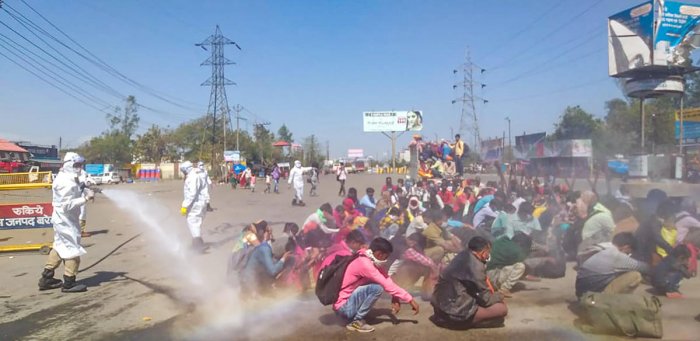
Millions of workers, labourers and vendors are facing economic extinction. Their shops are being ransacked by the police, daily-wage labourers are not being paid and migrant workers in the absence of any state-organized transport system are having to walk hundreds of kilometres to their homes while some are dying before completing those journeys. At the time of writing, deaths of 22 migrant workers have been reported. To top that off, news has spread that a group of migrant workers reaching Uttar Pradesh have been bleached by governmental authorities for them to be disinfected. It reveals the classic dystopian dictum of the state sanitizing the poor to save the rich. Sometimes this sanitization means outright annihilation.
The construction of a wall around poor settlements in Ahmedabad, is a manifestation of removing the poor from public vision, as visualized in the Netflix series Leila. The ghettoization and extinction of the poor to remove them from public spaces is a recurrent theme in dystopian literature. This immense inaction makes one think, of the possibility of the state, deliberately leaving people to die. The removal of the ‘different’, marginalized is the first step towards creating a human monoculture, which is the building block of any dystopia. The state knows that it cannot control the virus but can always regulate exposure to it. There is a triangle of dystopian strategies working here, a sophisticated network of ‘perfectly planned and beneficial, perfectly planned and unjust and perfectly unplanned’. All kinds of movement in public spaces are being regulated in a planned manner, food rations are planned to be unjust and the exodus of the migrant workers are left to be carefully unplanned. The attempted human monoculture makes everyone replaceable. We will all be Wilsons. The severely optimistic notion that crisis brings us together does not work in real life. The only thing that unites us right now is ‘planned’ hopelessness with a predictable sense of renouncing control.
This is the time, when the state is on the brink of turning authoritarian. Therein lies the danger of utilitarianism, that democracy is seen as means to an end and can be done away with when the need arrives. Hungary has already seen the world’s first ‘corona dictatorship’. Every person endorsing the ‘shoot at sight’ method for people violating the lockdown is signing a warrant for authoritarianism on the state’s behalf. The sinister way in which state has perfected order is scary. Covid-19 was a threat since February, yet the government started acting only in mid-March. This shows one important thing, that the state decides when it is dangerous enough, and when it can do away with democracy. Moreover, the state decides who are ‘dangerous’. The poor are dangerous, the NRIs returning from severely affected countries are not. Everyone must save themselves but the jailed and the poor in the detention centres can be left to die.
The biggest dystopian feature about this pandemic is the impossibility of morality as proposed by John Danaher. If people don’t practice social distancing, the pandemic is likely to spread causing a significant number of deaths and if people stay at home, many will die of hunger. There is no indication as to how one weighs the trade-off of lives. The lack of medical infrastructure prompts similar moral conflicts. Who do you provide treatment when there is a lack of equipment? As a final edifice of ignorance, I will refer to the statement of Dr David Nabarro, WHO’s special envoy on this pandemic, who commented the following on the Indian lockdown:
“I think it is courageous of the government, honestly, to take this step and provoke this enormous public debate and let the frustration come out, to accept that there will be hundreds of millions of people whose lives are being disrupted. For poor people on daily wages, this is a massive sacrifice they are making.”
We live in a world where a scarcity of life-and-death choices for the poor is lauded and patronized as a voluntary sacrifice. Dystopia is real and it is here to stay. It is no longer a point of culmination in the future but the perpetuation of a disastrous present.
Sujato Datta studies history at Presidency University
 Lokayata