
The Covid-19 or the novel Corona virus pandemic has affected vast sections of the world population and has already caused widespread damage in almost all aspects of human life. The world has come to a lockdown where people are being forced to self-isolate and not go outside to prevent the further transmission of the virus. Trade and economic activities, social interactions, political programmes, religious congregations—all have come to a standstill. Hospitals all across the world are overfilled with patients affected by the virus and the numbers are increasing with each passing day. Probably for the first time in recorded human history, a disease has occurred which leaves each and every person on the planet vulnerable to the risk of transmission. Very little can be said except for the fact that no one is quite sure when or how this crisis will come to an end. With a global economic recession underway, it is safe to predict that extremely tough times are yet to come. We need to understand that although the virus leaves everyone from the prince to the pauper at risk, the consequences of the total shutdown caused by the imminent threat are different to different people, societies and countries. This crisis leaves us with certain observations and questions which I will try to highlight in the following paragraphs.
I will begin with the observation regarding the world’s natural environment. We can see that with the near-total shutdown of work in industries and reduced vehicular traffic, pollution levels have come down drastically all over the world. Ozone layer depletion has reduced significantly. Clearer night skies have appeared in some of the most polluted cities in the world. Endangered species of animals have resurfaced after years. These instances put to question the accountability of the capitalist models of “development” that only sought to deplete the earth of its resources to facilitate “human progress”. This lockdown shows us how the planet is a better place to live in with these systems not in operation. These examples compel us to understand the importance of environment-oriented policy-making. It also makes us understand that battling climate change is a matter of will and not ability.
While talking about the lack of resources under capitalism to counter such a problem, we shift our focus to the importance of public healthcare systems. We have seen how Italy, touted as a country having “one of the best healthcare systems in the world”, has ended up being the worst-affected country with death tolls beyond comprehension. The major problems which have caused so many deaths in many countries in Europe and the USA are: 1) Lack of healthcare access to majority of the citizens due to the high prices and unpreparedness of the medical system to handle patients in bulks; 2) Negligence in efforts to counter the pandemic. These problems emerged from the lack of universal healthcare coverage for the citizens and a feeling of complacency in the governments regarding the infallibility of their systems. This came from a larger belief in the stability of the capitalist systems. Probably, the governments could hardly imagine that the virus could affect the rich classes. When they realized it did, the damage was beyond control. We thus get a clear idea about the dangers of privatization of healthcare and how powerless these profit-oriented systems are, in the face of such problems.
The class character of these economic models which prioritize the wealthy more than the working class is evident. The parameters of judging the quality of healthcare facilities in countries also have a similar class bias and need to be reconsidered. Interestingly, Spain has nationalized its hospitals and moved towards more “socialist” solutions. Socialist countries like Cuba and Vietnam have fought the virus more successfully than other countries and Cuban doctors have been deployed in Italy to treat patients. We must also remember that the countries which have proper free universal healthcare facilities in place have been able to fight the disease with more efficiency than the countries that do not have so. These instances effectively silence the arguments that capitalism is a system without a viable alternative.
Also, they raise important questions about the existing IPR regime regarding pharmaceutical drugs and medical equipments. We have seen how large corporate pharma companies in the USA, with backing from the Trump administration, have cited IPR claims to maintain exorbitant prices of essential medical drugs and equipments and made it impossible for the masses to get access to those goods and services. With the increased need of development of vaccines and antidotes for the Covid-19 virus, the existing IPR framework regarding medicines and medical equipments raises the important ethical question: Are lives of human beings less important than securing patented monopolies and making subsequent profits out of them? This crisis also makes a case for the increase in government funding in R&D in the medical field.
Next, we move into the questions of value of labour and the importance of labourers in the economy. With minimal damage to the natural and man-made resources, share markets have plunged into all-time lows and the world is going through a recession. What might be the reason behind these economies facing near-collapses when the labourers stopped working in the organized and unorganized sectors? Labour adds value to the goods and services and the Marxist labour theory of value stands validated in this scenario. We have realized the worth of the otherwise unrecognized labour of manual labourers and sanitation workers and have understood how our economies depend on the working class to “grow”. We have also understood the importance of having expert professionals (doctors specifically, in the current scenario) and competent technocratic governments to counter such crises. There has been a reinstated belief in scientific temper and rational thinking, with people being forced to focus more on maintaining personal hygiene in scientific manners. Populism has had a setback, especially in Europe and the USA, and governments have been forced to take concrete policy decisions. However, populism can revert back in newer forms through propaganda mechanisms, if the people are somehow falsely convinced by their governments that they have made radical changes in outlook in the face of the current crisis.
We have been made to realize the paramount importance of the Internet in our quarantine days and the crisis makes a case for free Internet access to everyone. The importance of artists: musicians, actors, filmmakers, visual artists, writers, poets, theatre artists, when we have sought refuge in the world of web series and art through social media and online streaming sites in our “quarantine” days is evident too. These professions are devalued in our society, as they are considered being of “less utility”. Materialistic judgements about the functional utility of art in terms of their “contributions” to the economy need to be questioned. It also showed us the importance of domestic labour. Women have been traditionally compelled to do unpaid, unrecognized domestic labour since the advent of patriarchy. This form of labour facilitates reproduction of social inequalities. With a sizeable population of the world locked down inside their houses, women are being forced to work even more in their household. Alarming statistics state that domestic violence has increased during this period in certain countries. Patriarchy is closely linked with capitalism, and we need to ask questions which are otherwise left unaddressed.
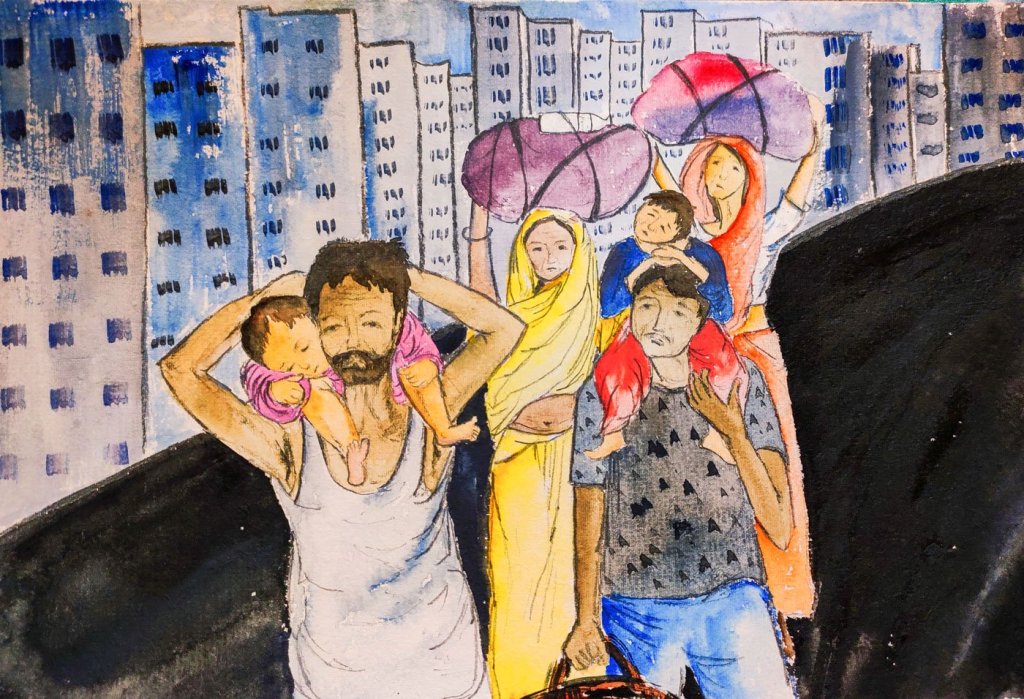
I want to further address the nature of the quarantine/social distancing/self-isolation/lockdown in the Indian context. The 21-day lockdown was announced by the Prime Minister a week back. He mentioned that all Indians are to stay inside their houses for three weeks to flatten the curve of transmission of the virus. The class bias of the lockdown was clear from his statement as it was addressed, quite evidently, to the people who have their own houses and can afford to be indoors for 21 days without losing their livelihoods and incomes. Unfortunately, no concerns about the farmers, homeless people, migrant workers, slum-dwellers, contractual workers and daily wage earners were addressed. We saw heart-wrenching pictures and videos of thousands of migrant workers stranded helplessly in bus terminuses of Delhi. In utter misery, they are being forced to walk towards their homes covering hundreds of kilometres. Quite a few have died on the road. With the shutting down of industries and roadside dhabas, millions of industrial workers and daily wage earners have lost their livelihoods.
The agrarian economy has faced a major setback because the farmers had to leave the cultivation of kharif crops incomplete. The central government has taken insufficient steps to compensate for the losses incurred by the farmers. The lack of proper public distribution systems has left millions of rural people without food and other essential goods to sustain themselves without their incomes. Transport workers too have suffered huge losses, owing to the complete shutdown of inter-state trade. Helpless daily wage earners who have come out of their houses to find work to feed their families have been subjected to police brutality in many parts of the country. Harmful chemical disinfectants have been sprayed on migrant workers to “sanitize” them. 1.7 lakh crore rupees have been invested to provide relief to labourers of the organized and unorganized sectors without any proper troubleshooting mechanism in place. The NRIs stuck in foreign countries have been safely airlifted back to India for free, while migrant workers have to walk hundreds of kilometres to reach their homes without any assistance or rehabilitation from the government.
The Prime Minister has recently opened a private charitable trust called “PM-CARES” and has called for donations to help the government fight the crisis, in spite of having central government funds like the Prime Minister’s Disaster Relief Fund. The noble intention behind setting up PM-CARES is extremely doubtful as the ministers are not trustees of this fund under their ministerial capacities. Thus, the donations collected and the money spent will not go through CAG audit procedures. The role of some of the corporate-owned media houses has been extremely saddening as they have blatantly glorified the central government and overlooked its mistakes. These efforts of creating public consent and gaining support by the governments through the corporate media apparatus even after being guilty of making grave mistakes and not admitting them is a major problem we need to be aware of. However, there have been many journalists who have risked their own lives and reported cases in unbiased and critical manners. They have tried their best to ascertain that the people are aware of the ground realities and the governments are on their toes. The rise of populism can be countered only by journalism of the latter kind.
Looking from a broader perspective, this crisis has reinstated people’s beliefs in the inter-connectedness of their fates. The kind of individualistic, self-interest-driven mindset, socially conditioned within people by the neoliberal states, has proven to be fatal as we realized that our well being is equally dependent on the well being of all other people in the world. This crisis and its consequences also tempt us to question the nature of “globalization”. In the post-Soviet era, we have seen the “liberalization” of markets in most of the countries. These markets have been “opened up” to investments by powerful MNCs. This has paved way for the globalization of capital, through trade and direct investment. This has also made us believe in a superficial sense of interconnectedness and interdependence. However, the economic superpowers have virtually established hegemonic (or so to say, imperialistic) control over many Third World countries through direct investment in government and private sectors, through “humanitarian” aids, through debts and subsequent debt-traps and also through cultural means. Presently, this globalization has contributed largely to the worldwide spread of the virus.
Thus, the Covid-19 pandemic forces us to rethink some of the basic questions: How “liberal” are neoliberal economies? How “free” are the free markets? Are capitalism and bourgeoisie liberalism equipped to solve crises of this scale? Are there really no viable alternatives to these systems? Is self interest still a viable basis for economic models to function on? How “welfare-oriented” are welfare states? Is overpopulation really the root cause of all problems, or is it capitalism that puts the onus on individual agency? These questions might seem irrelevant in these troubled times, but in anticipation of tougher times, we must engage with the questions I tried to highlight in this article. Modern problems might need modern solutions, but some modern problems need modern rethinking of much older questions.
 Lokayata