
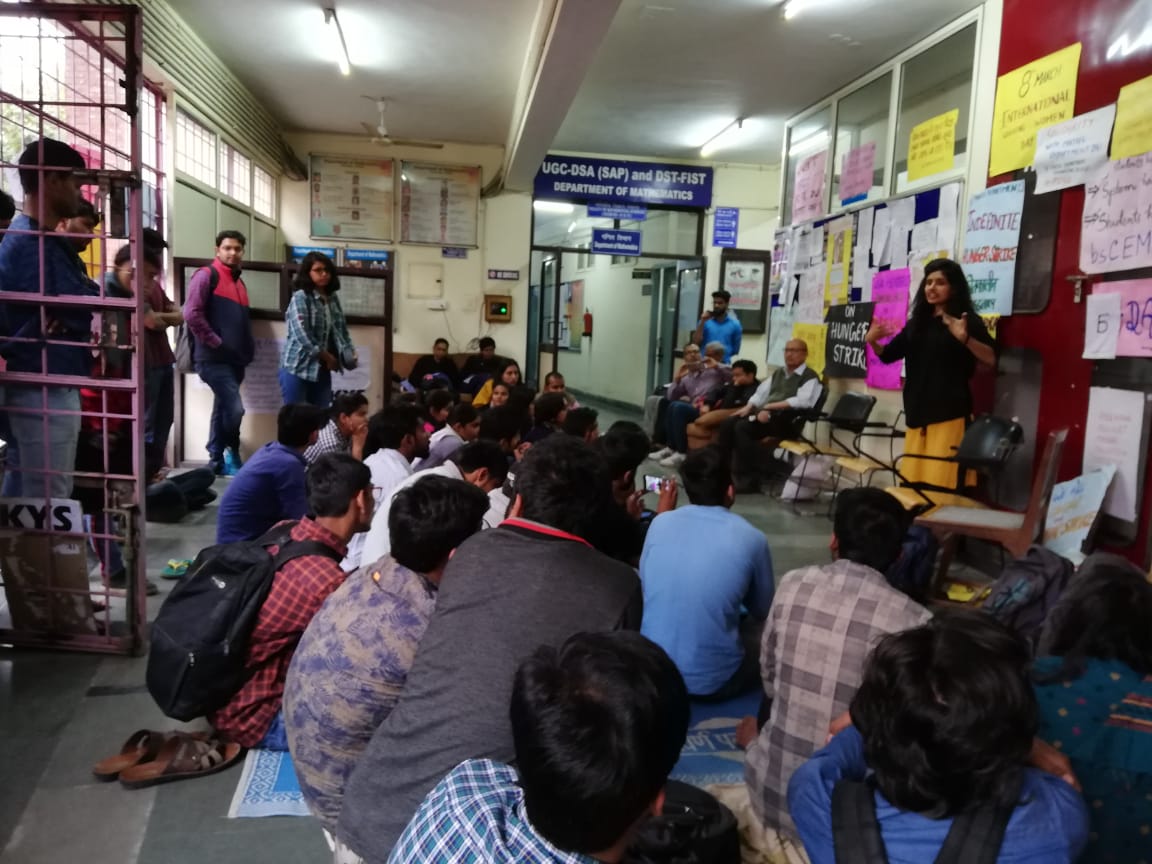
Three days ago, a peaceful hunger strike by the students of the Delhi University Mathematics Department and other students present in solidarity was disrupted by over 50 policemen and women who appeared on the scene and announced that the ‘protest period’ was over. The police detained 3 SFI activists for at least 3 hours, and took one of the students to Hindu Rao hospital where they tried to force-feed him saline water in order to break his hunger strike. Earlier in December 2018, in the same North campus, a PhD student from the Delhi School Economics was stabbed multiple times by a couple of phone snatchers late at night at Patel Chest, right opposite the Maurice Nagar police station. Even after handing over helpful details such as the number of the bike to the police, no action has taken place.
Off the top of my head, I can name several such instances where police action (or lack thereof) really cannot be logically explained. The Ramjas Riots of 2017 and countless other instances in the campus of violence unleashed by ABVP as a result of which many students and teachers have been severely injured, have failed to attract any acknowledgement by the police, even at times when the police have been present at the scene. On the other hand, students and teachers from left-wing groups as well as other organisations active in the campus have, time and again, come face to face with the brutality of police action. Why do some instances provoke such a disproportionate police response, while some invite no response at all? Whose safety is the police really looking after? What constitutes a ‘threat’? Can we see a pattern of ‘selective’ and biased action by the police in campus? These are all important questions that one must ask when it comes to the safety of students in the Delhi University campus.
Let us turn to the other side of the story, and take a look at official data published by the Delhi Police. The official website is quite prompt in announcing their press releases, especially to publicise their own initiatives such as a mega job fair for the youth. However, in the Press Archives of Delhi Police, nothing has been published by the Maurice Nagar branch since February 2018. Does this mean that no crime has taken place in this area of North Delhi for the past one year?
It is not difficult to ascertain that this is a false picture being created by police data, for one knows of numerous instances of violence (most commonly by ABVP students), robbery, theft, harassment, and even instances of stabbing that have taken place in this short time frame. In fact, the last month in North campus has been characterised by violence and hooliganism in the aftermath of the protests against the V-tree puja at Hindu College. Students have been physically attacked by ABVP groups in broad daylight, often in the physical presence of police officials. Even subsequent protests against said violence have provoked further violence against protestors, making the campus extremely unsafe for all those who raise their voice against this disruption of peace in North campus.
At the beginning of the previous academic year, the Delhi Police also announced some new initiatives aimed at the safety of women, such as the deployment of women police specially trained in martial arts, and the setting up of police picket points with a special assistance to women’s colleges. But why, then, is the police so fearful of women students themselves?
I recall my own experience at a Pinjratod protest last year at Arts Faculty where there were about 20 odd women, sitting in a circle, singing songs and raising slogans. Surrounding us were at least a dozen men and women police officers as well as paramilitary officials, all armed with lathis, machine guns, water cannons, and other kinds of guns that I couldn’t even identify. But where was the police when women protestors were being pushed and shoved around by men from Hindu College and ABVP on the night before the V-tree puja? Oh, wait – the police, too, was busy shoving and pushing around women protestors, as I was told by 2 women who were present at the incident. At the earlier mentioned recent hunger strike too, the police physically assaulted several women, pulling their hair and manhandling them. Why does the same authority that claims to protect us, also consciously and consistently terrorise us?
The aim of this article is not to vilify the police, but to criticise the skewed pattern of its activity. I write with the knowledge that the police force is usually a mere puppet in the hands of its political masters. The system and infrastructure that the police force operates within are outdated, and in immediate need of reforms. It is important, here, to mention that the Delhi Police is actually accountable to the central government and not the Delhi government, despite consistent demands by the AAP government to bring the centre-run Delhi Police under the control of the state government. It is, then, not difficult to draw a link between the actions of the Delhi Police and the broader idea of state interference – both of which seek to impose a certain (and very similar) ideology on its subjects.
Processes such as the shrinking of spaces for criticising the actions of the government, the clamping down on dissent, and the curtailing of academic and intellectual freedom have rapidly intensified over the last few years. Time and again, peaceful protests and demonstrations have been disrupted and activists have been labelled as ‘anti-nationals’. I see this as a deliberate attempt by the state to shape a certain kind of student who will become a certain kind of citizen – one who will conform to and subsequently reinforce its ideology. In doing this, the very state that claims to protect us also actively instils fear in us. It is imperative that we raise our voice against this kind of state interference and surveillance. I end with the question that we all need to ask ourselves: why has safety on campus become a selective due that one is entitled to only if one is an upholder of the state ideology?
 Lokayata