
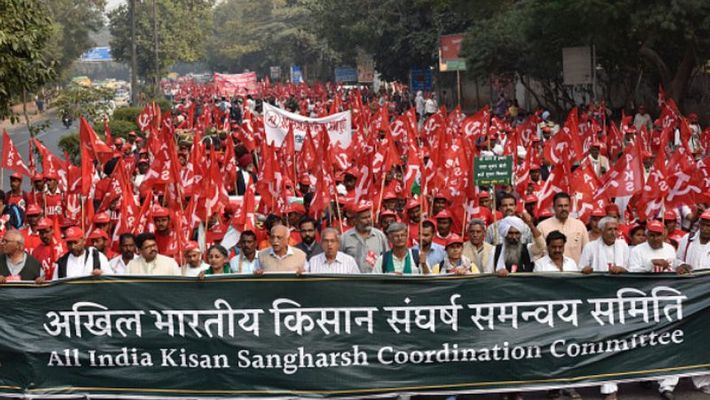
The Kisan Mukti March, which took place in New Delhi on the 29th and 30th of November was neither an isolated occurrence nor an end in itself. It raised some crucial questions, which are yet to be answered. It was a historic happening in the sense that it enabled an unprecedented encounter between urban and rural India — mutually dependent spaces which are portrayed as being disparate in the media. It is as though they were linked in a food chain, with one living by devouring the other. It is through this representation of their relationship that shared realities, unforeseen exchanges, and unending dialogues get ignored in public discourse. The urban-rural dichotomy in India is therefore a deliberate political construct to prevent city and village dwellers (and voters by implication) from coming together. The colonial policy of divide and rule continues in post-colonial times under the garb of discussing rural and urban problems in isolation from each other for apparent convenience.
This begs some clarification regarding how exactly such problems are inter-related. Journalist P. Sainath has noted that for the first time since independence the absolute increase in population was more in urban areas than in rural areas (9.1 crores as opposed to 9 crores) as per the census of 2011. Since the birth rate in rural areas remained higher than that in urban areas (23.3 as opposed to 17.6), it can only be concluded that this ‘increased urbanization’ occurred at the cost of rural depopulation, which was severely aggravated by the agrarian crisis that India is now facing. In the absence of adequate opportunities for proper skill-development, and for alternative remunerative employment, this increase in urban population is neither adding significantly to social production nor to collective consumption.
These unrewarding migrations from rural to urban areas create an added impetus for expressing the anguish of farmers in India through the metaphor of marching to the cities, which remain quintessential and secluded centres of political power, notwithstanding the implementation of the three-tiered Panchayati Raj system. These marches acquire greater significance as symbols of resistance, as organized attempts at redemptive migrations, seeking to make good the grievances of previous ones. These give voice—no matter how inaudible—to the rural underdogs in the competitive urban scene. The Kisan Mukti March was one such effort, and was distinguished by its sheer magnitude.
I had first heard the call for this march in June 2018 when Sainath delivered the Saroj Mukhopadhyay Memorial Lecture at the Yuva Kendra Auditorium in Kolkata. It was my personal introduction to the phenomenon of systematic de-voicing of the peasantry in India, which had reached such an extent that the only way left for peasants to communicate the actualities of their predicament was through committing suicide. From 1996 to 2015, there have been over 300000 recorded instances of recognized farmers committing suicide in India. The government has stopped publishing data regarding this—following failed attempts at distorting the same—since then.
The demands for providing redressal to the food producers of the country, for implementing the Swaminathan Commission’s recommendations, for addressing the problems of India’s ‘Mega Water Crisis’ (to quote Sainath), the Agrarian Credit Crisis, and the issues of recognition faced by the dalit, tribal, and women farmers had precipitated the formation of the All India Kisan Sangharsh Coordination Committee (AIKSCC). It was this representative body of more than 200 peasant organizations of the country which called for a march to be held in the capital city, culminating in a demonstration on Parliament Street.
The Kisan Mukti March, as it was called, was largely prefigured by the Long March from Nashik to Mumbai, which took place in March, 2018 covering 183 kilometres and involving some 50000 tribal farmers. It was the crucial decision taken by the marchers to continue marching at night—in spite of being dead tired from the day’s toil—so as not to create any hindrance for the CBSE examinees the next morning, which set a moral obligation for the students to reciprocate, and so they did in Mumbai. When it came to be known widely that a march furthering the one held at Maharashtra would take place in the heart of the capital city, volunteer groups—initially nebulous, later momentous—came to be formed almost overnight. Under the aegis of the pan-India group called ‘Nation for Farmers’, regional, occupational, and institutional sub-groups of volunteers crystallized. ‘Students for Farmers’ in general and ‘DU for Farmers’ in particular were among the plethora of such groups. These groups were organized overtly through meetings on campuses across Delhi and their reach was made much wider through campaigning on social media, and in a subtler way through circulation of invites in the form of messages over WhatsApp.
Save for the ‘Swaraj India’ group led by Yogendra Yadav, other prospective volunteer groups for the Kisan Mukti March were largely decentralized, often with a few convenors conveying important information from the AIKSCC. There was something subterranean about the organization of this public movement which greatly informed its anti-establishment character and emphasised the need for urban residents to solidarize with the farmers coming from all over the country.
Mario Savio once said in a speech inside the Sproul Hall of the University of California, Berkeley (1964), that “There is a time when the operation of the machine becomes so odious, makes you so sick at heart, that you can’t take part. You can’t even passively take part. And you’ve got to put your bodies upon the gears and upon the wheels, upon the levers, upon all the apparatus, and you’ve got to make it stop. And you’ve got to indicate to the people who run it, to the people who own it—that unless you’re free, the machine will be prevented from working at all!’ The farmers of the nation had reached such a point and ‘Nation for Farmers’ could not but solidarize with them!
The farmers and volunteers from different states started pouring into the five different assembly points—Anand Vihar Railway Station, Gurudwara Bala Sahib at Sarai Kalekhan, Gurudwara Majnu Ka Tila, Sabzi Mandi, and Barat Ghar near the Bijwasan Railway Station—on the evening of 28th November. The various Gurudwaras of Delhi made generous provisions for dedicated langars, so as to cater for thousands of farmers for over two days and contributed immensely to the cause of the march.
The pre-procession ambience at Gurudwara Majnu Ka Tila on the morning of the 29th resembled a lull before the storm. In an improvised meeting at the Gurudwara Hall, it was decided that the farmers would march in two rows, sloganeering all the way, towards Rajghat, while the volunteers would take recourse to public transport to reach ahead and set up camp for distributing refreshments there. Meanwhile, the student volunteers from Himachal Pradesh sang and danced to songs of the hills on the Gurudwara ground as all the other participants congregated around them. In the context of the Kisan Mukti March, these could not but be seen as songs of resistance too, with the aim of mobilizing the masses.
The volunteers set up camp for distributing refreshments at Rajghat—the common point for many wings of the march to pause on their way to Ramlila Maidan—in front of the Gandhi Museum. To free up enough space, some heavy metal barricades of the Delhi Police, placed as fixtures on the pavement, had to be lifted and placed along the wall. This was closely followed by a hellish noise created by police vehicles dragging a long trail of such barricades down the road, towards Ramlila Maidan, heralding the arrival of the first wing of the march. The former acted as a metaphor for people lifting the weight of the state on their own and the latter as a metaphor for the state dragging its ungainly weight behind itself, summing up the difference between the approach of the masses and that of the powerful.
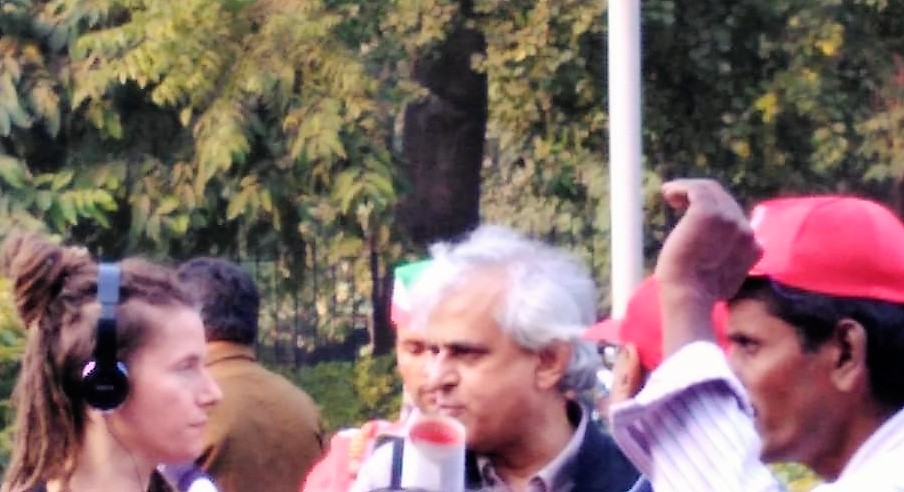
As students and teachers of Delhi University raised slogans at Rajghat, people from within cars which paused at the signal displayed emotions ranging from mere curiosity to a full-fledged Laal Salaam—annoyance wasn’t one of them. Theatre personality Moloyashree Hashmi, representing ‘Artists for Farmers’, briefed the student volunteers on how to go about distributing biscuits and sweet bread among the farmers tired from marching hour after hour. Soon they arrived. In wave after wave. They came, they sat down on the road for a while, and then continued to march ahead. The volunteers worked with all their zeal to keep the road and the pavement spotlessly clean after each wave departed. One could easily spot journalists Ravish Kumar and P. Sainath marching along with the farmers. As soon as the last wave arrived, the volunteers followed their suit. All roads led to Ramlila Maidan that day.
Amidst slogans of ‘Awaz Do! Hum Ek Hein!’ (Raise your Voice! We are One!) Ramlila Maidan was reached. It was to be an evening abound with cultural performances. ‘Ek Shaam Kisan ke Naam’ (One Evening in the Name of the Farmers) it was called. The chiaroscuro created by the presence of a light here and the absence of another there, the sumptuous smell of food being prepared in the langar set up nearby, the ecstasy of tired limbs moving to the melodies of songs against oppression, the fiery rhetoric of the occasional speech acting as a filler between performances, and the sea of people having poured in from different states of the country had truly turned Ramlila Maidan into a microcosm of rural India that evening.
If one had a probing eye, one could easily locate a number of social activists among the crowd there. Some did spot Bezwada Wilson entering the Maidan at about seven in the evening. Jackets and other warm clothing exchanged hands as many volunteers stayed back for the night, to bask in the warmth of stories of the soil told by the most credible voices, as others bade farewell and conveyed revolutionary greetings, some vouching to return the next day. Unlike in other political rallies, Ramlila Maidan was only a transit spot in this case. A means to an end. A place of gathering before the final march unto Parliament Street.
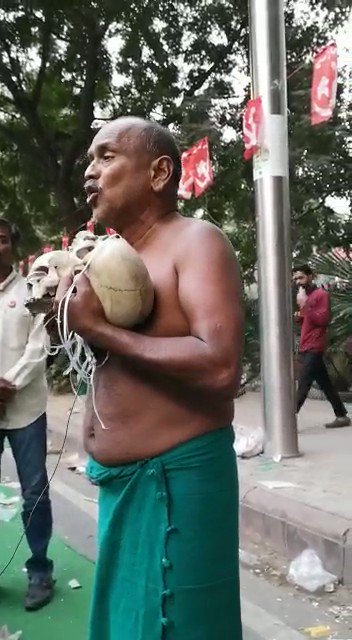
As trainloads of farmers arrived one after another to raise the ever-increasing numbers of participants on the morning of the 30th, students and ordinary citizens kept joining the ranks of this extraordinary march. Slogans were raised, yet more songs sung in different tongues, flyovers crossed in unison, and everyone marched onward until the ‘hallowed’ dome of the Sansad Bhavan could be seen. Activists and opposition leaders addressed the gathering and so did Salee Parimal and his comrades from Tamil Nadu, who protested with the skulls of their kinsmen who were compelled to commit suicides by their ever-increasing indebtedness. Even the silence of the women from Telangana, whose sons, brothers, and husbands had been driven towards suicide by debt burdens, and who marched with the framed photographs of their loved and lost ones, could raise the loudest of all voices.
The recent announcement of agricultural loan-waivers by the newly elected governments in the states of Rajasthan, Madhya Pradesh, and Chhattisgarh—following the defeat of the erstwhile ruling party—is a partial and stop-gap solution. This is not enough to even decelerate, let alone stop the ensuing agrarian crisis. Structural inequalities in this sector can only be eliminated through long term and dedicated policy measures involving significant changes. This is an uphill task considering the present obsession of the Indian body politic with politics of religion and religion in politics. The farmers who marched didn’t ask the volunteers what their religion or for that matter, caste, creed, or gender was. Neither did the volunteers.
The Kisan Mukti March embodied a sense of fraternity and above all, it exemplified a shared humanity. India is a land of paradoxes. As Amartya Sen has pointed out, it is a country that indulges in extravagant over-production and yet suffers from severe under-nutrition. The choice to free the nation from these obscene ‘unfreedoms’—to quote Sen again—lies with the masses, who have the right to vote and the power to critique. Dante Alighieri once wrote, ‘The darkest places in hell are reserved for those who maintain their neutrality in times of moral crisis’. The subalterns did speak through the Kisan Mukti March this November. The question, however, is – were we able to hear them?
 Lokayata
One thought on “When the Farmers Came Marching and Students Sang: A Participant Observer’s Guide to the Kisan Mukti March — Suchintan Das”